
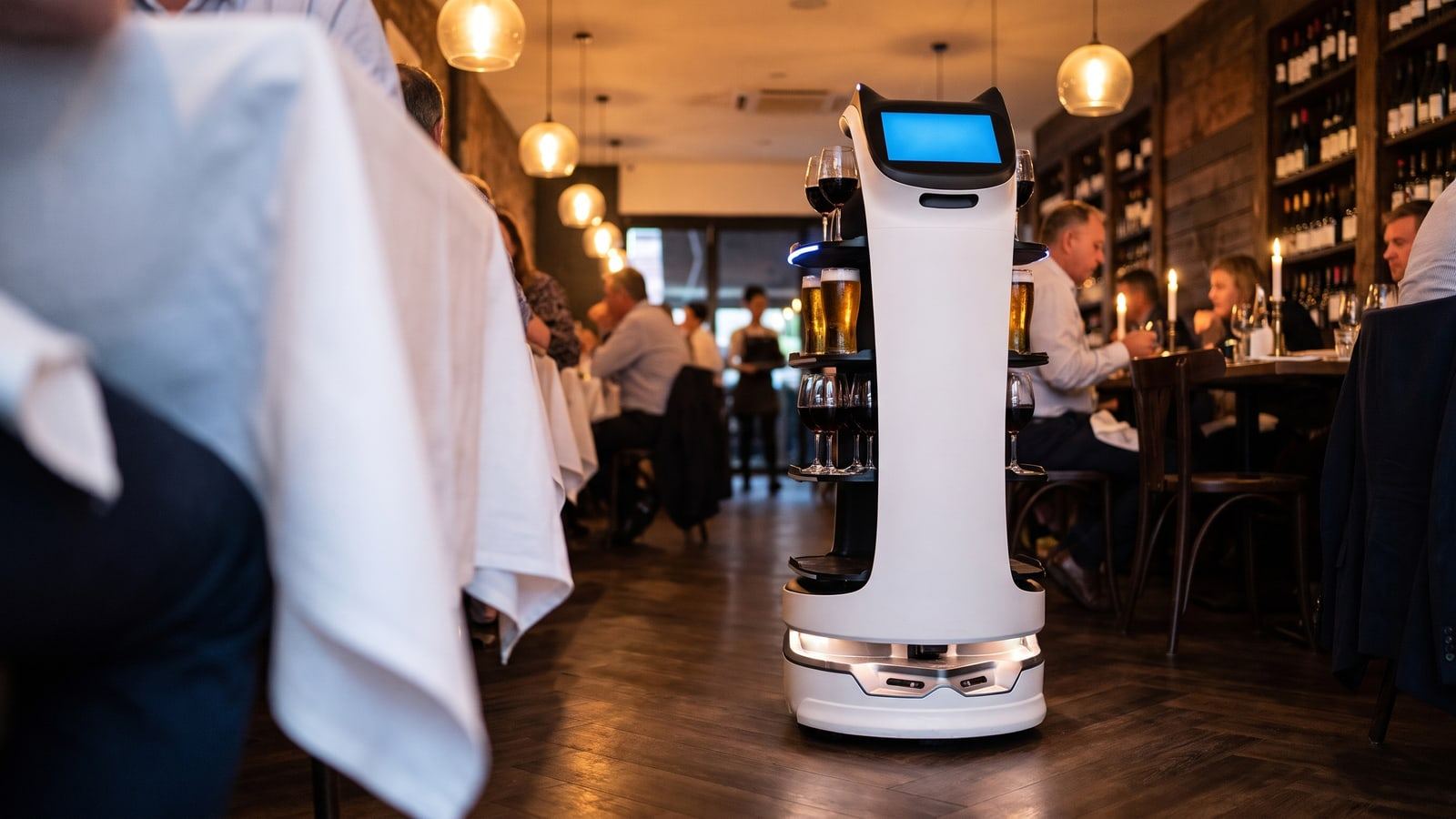
If a waiter pours a drink over a guest’s trousers, the restaurant answers for it. If a robot does the same, the restaurant still answers for it. “A restaurant operator is liable in both cases,” Ina Ebert, a legal scholar who works on emerging risks at Munich Re, told Börsen-Zeitung last week. After that, the restaurant can turn to the maker or the software supplier.
What that second step is worth changes on 9 December.
What became law in October
Germany’s new Product Liability Act passed the Bundestag on 8 October, cleared the Bundesrat on 16 October and was published on 27 October. It applies to products placed on the market from 9 December and brings a 2024 EU directive into German law.
Three changes matter for robots. Software counts as a product, which pulls in the makers of AI systems. The old ceiling of 85 million euros on a manufacturer’s liability for injuries goes, along with the 500 euro excess on property claims. And a court can now assume a defect when a product is too technically complex for the injured person to prove one, provided that person shows a defect is likely. Ebert calls AI a black box, because often nobody knows how the system reached its result. This rule is the law’s answer to that.
The update is now part of the machine
A product used to be judged as it left the factory. Under the new act, a maker who can still supply updates has kept control of the product, and that changes the test. The defence that a robot was sound when sold no longer works if the fault came from its software, from an update, or from a missing update needed to keep it safe. A digital service the robot needs for one of its functions counts as a component. Courts must also weigh what a product’s ability to keep learning does to it after sale.
We argued in August that robots, unlike most machines, gain abilities after you buy them. From December, the same link back to the maker keeps the maker responsible.
Who stands behind a robot built elsewhere
If the maker sits outside the EU, the importer and the maker’s appointed representative in the EU are liable as if they had built the machine. That covers humanoids from China and the US. It also covers anything coming off the new line in Serbia and robots built in Switzerland, since neither country is in the EU. On the wording of the act, a company that brings a robot in directly and rents it out to a customer could find that the importer is itself.
If nobody in the EU can be found, every supplier in the chain is liable like the maker unless it names one of those parties or its own supplier within a month of being asked. A supplier is any business in the chain that hands over a product for sale or use, paid or not. For anyone renting out robots, the paper trail back to the importer now has a legal job.
The Bundestag has its own doubts about the last link. Alongside the act it asked the government to examine whether representatives of non-EU manufacturers should have to carry liability insurance, so that they can actually pay claims, and whether a compensation fund could work. A liable party only helps if it can pay.
Changing a machine brings its own risk. Anyone who substantially alters a robot without the maker’s consent and then puts it to work becomes the manufacturer of the altered machine, and a new ten-year liability period starts. Anyone retrofitting autonomy onto machines people already own will want that consent in writing.
What the law does not pay for
This is the part that matters most to an owner. The act compensates natural persons. It does not cover the defective robot itself, and it does not cover property used only for business. A person hurt by a robot is protected. An owner whose fleet stops for a week after a bad update is not. Those lost hours come on top of the ones already lost between customers and on the charger.
The EU directive adds two points in its recitals. It does not oblige anyone to provide updates. And a manufacturer is not liable for a missing update where the owner failed to install one supplied to keep the product safe.
So the owner’s loss stays a matter of contract and insurance, and both are still being written. Adrian Reisch, a partner at EY who works on physical AI, told Börsen-Zeitung that there are no general rules yet and that each project agrees its own contract on who is liable for what. Because those questions are open, the paper reports, humanoids in factories work in their own rooms rather than beside people. “That limits the advantages of such robots,” Reisch said. The first large insurers are still working out whether humanoids can be insured at all.
Andreas Schumacher of Munich Re has a name for the risk that comes with shared software: “software-defined accumulation risk”. When many customers run the same model, one fault or one attack can hit many robots at once. A pool that owns machines from several makers, like the beep Robo-Pool, is less exposed to any single update.
What it means for owning robots
Five questions are now worth getting answered in writing before a machine goes to work:
- Who is the importer or representative in the EU, and can it pay?
- How long will the maker supply safety updates?
- Who installs them, and who keeps the log?
- Has the maker agreed to every change made to the machine?
- Who carries the lost hours when a fault or an update stops it?
The rental rates in our catalogue show what a machine can earn. The answers to those five questions decide who pays when it cannot.
What is not proven
No court has applied this act to a robot yet, and terms such as “substantial change” and “control” will be settled by judges. Machines placed on the market up to 8 December stay under the old act, and how that works for an older robot that receives a new update is an open question. Whether a given rental company counts as a supplier or an importer depends on how it is set up. That is a question for its lawyers, and this article is not legal advice. Switzerland is outside the directive and keeps its own product liability act. Insurers have little claims history for humanoids, so today’s cover and prices may not last.
The act settles who answers to the person who gets hurt. Who answers to the owner is still being written clause by clause.