
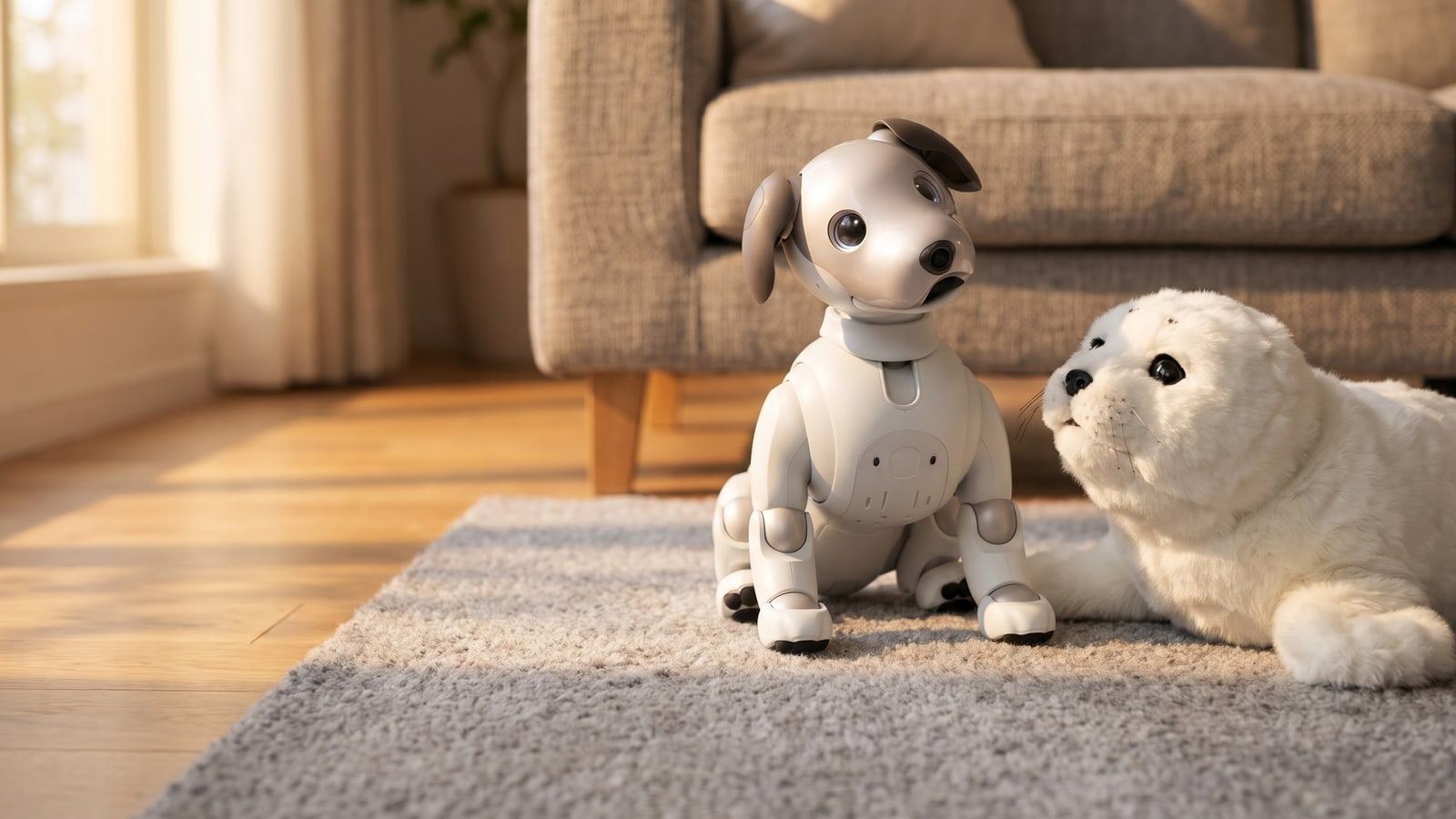
This blog usually judges robots by the hours they work and what they rent for. This week, a lighter list: seven robots people like having around. It is less frivolous than it sounds. A robot that works among people needs those people to let it, and several makers have found that a face, a tail or a fluffy coat is one of the cheapest ways to win that permission. Here is what each of the seven does, and what its cuteness is for.
1. Felis, the cat that turns over in midair
Felis is a research robot built by a team from MIT, the University of Hong Kong and the University of Pennsylvania, with Zhiyang Dou as project lead. It borrows the trick of a falling cat, which turns over in the air by bending and twisting its body so that its front and back halves rotate against each other. Felis joins two body halves with a motor-driven joint at the waist and gives each leg a single motor: six motors in total, half the twelve of a typical four-legged robot. Dropped upside down in physics simulation, it turns over and lands on its feet in about two thirds of a second. It also walks, turns, jumps and moves in time with music.
For an owner, the interesting number is the six. Every motor is a part to buy, power and repair, so a body that does more of the work with fewer motors is a cheaper machine to keep running, if the idea survives the step from simulation to a real floor. The robot on the project page is the team’s third version, built at MIT.
2. BellaBot, the waiter everyone forgives
Pudu Robotics’ BellaBot carries dishes on its trays and shows a cat face on its screen, which changes expression when someone pats its head. Skylark, which runs Gusto and other family restaurant chains in Japan, set out to put 3,000 of them into more than 2,000 restaurants. In July 2023 one of them spilled the beer it was carrying across a Gusto restaurant and rolled away with its usual proud smile. Photos of the scene went viral, and people liked the robot more for it. Users joked that it was hard to be angry with a cat.
A robot that serves customers will make mistakes in front of them. We wrote last week about who pays when that happens. A cat face does not change who is liable, but at Gusto it turned a spill into a photo people wanted to share.
3. PARO, the seal that went to work on a lease
PARO is a robotic baby harp seal that Japan’s National Institute of Advanced Industrial Science and Technology, AIST, began developing in 1993. Each one is partly made by hand, learns to respond to its own name and charges through a plug shaped like a baby’s dummy. It entered Guinness World Records in 2002 for its healing effect, and by 2004 it had been tried in care settings in Sweden, Italy, France and the United States. On 20 September 2004, Japan’s Respect for the Aged Day, a spin-off company began providing it to care homes on lease.

That makes PARO one of the oldest cute robots with a paying job, and its first customers rented it rather than bought it, more than twenty years ago.
4. LOVOT, built to be loved and nothing else
GROOVE X in Tokyo says its LOVOT has exactly one role in a home, which is to be loved. The round, wheeled robot keeps its body at about 37 degrees, follows people from room to room, greets them at the door and lifts its arms when it wants to be picked up. When its battery runs low, it drives back to its nest and charges itself, and the maker says it is active for up to 16 hours a day. Its software is updated through the cloud, and the maker promises ongoing care and repair.
LOVOT is the clearest case of cuteness as the product rather than a coat of paint on one. It also shows what an owner is really buying: the machine plus the service that keeps it lovable. And like a warehouse humanoid, it lives by the share of the day it spends off the charger.
5. aibo, and what happens when support ends
Sony launched its AIBO robot dog in June 1999. The first 3,000 sold out in 20 minutes, and more than 150,000 were sold before production stopped in 2006. Sony kept its AIBO Clinic open until March 2014, AFP reported, and then told owners they were on their own. A repair firm called A FUN, drawing on former Sony engineers, filled the gap, using dead dogs as donors of spare parts. Before it takes them apart, it holds a funeral for them at the 450-year-old Kofukuji temple in Isumi, east of Tokyo. One ceremony in April 2018 honoured 114 dogs. Sony launched a new aibo that year but did not resume repairs of the old models.
For anyone who owns robots, the aibo funerals are the most useful story on this list. Affection did not keep spare parts coming. Support did, and when the maker withdrew it, a third party had to rebuild it from donor machines. Who fixes a robot decides how long it lives.
6. Reachy Mini, the one you can fix yourself
Reachy Mini, from Pollen Robotics and Hugging Face, is a 28-centimetre desktop robot with a camera, four microphones and two animated antennas. It comes as a kit, is programmed in Python, and its makers have committed to publishing both its software and its hardware as open source.
Next to aibo, the contrast is the point. A robot whose designs and code are public does not depend on one company keeping its clinic open. Open source is no promise of support, but it lowers the risk that a machine dies because its maker moved on.
7. Olaf, the star who fell over
At Disneyland Paris, Disney’s new World of Frozen area opened on 29 March with a free-roaming robot of Olaf, the snowman from the films. It moves its mouth, eyes, carrot nose and arms and can talk with guests. Within days, a video showed it freezing mid-sentence and falling backwards, its nose bouncing off the ground, before two staff members carried it away. The clip was viewed more than 4.6 million times on TikTok.
Olaf shows both sides of a cute robot in a crowd. It is the attraction people come to see, and when it fails, it fails in front of all of them.
What cute buys, and what it does not
Across the seven, cuteness does three jobs. It buys acceptance in places where nobody asked for a robot: a family restaurant, a care home, a crowded theme park. It buys forgiveness when the robot gets something wrong, as the beer at Gusto showed. And in the home robots it is the product itself, sold together with the service that keeps it going.
It does not buy reliability or spare parts. Olaf still fell over, and old aibos still needed donors. For a pool that rents machines into restaurants, hotels and care homes, like the beep Robo-Pool, a friendly face is one more reason a customer might keep a robot on the floor. It is no reason to skip the questions about uptime and service.
What is not proven
This is an editorial selection, not a ranking. Felis’s stunts are shown in physics simulation, and the team lists its code and technical report as coming soon. The Skylark figures date from 2022 and 2023, partly from Pudu itself, and Pudu’s satisfaction survey covered eight restaurants. PARO’s early results come from its developers’ own trials. LOVOT’s figures, including the 16 hours, are the maker’s. Pollen Robotics sells Reachy Mini as an early product without warranties. And we know of no study that links a robot’s looks to how many hours it is rented, so the case for cuteness as a commercial asset still rests on stories like the beer at Gusto.
Cute robots make people smile. The ones that last will be the ones somebody keeps fixing.