
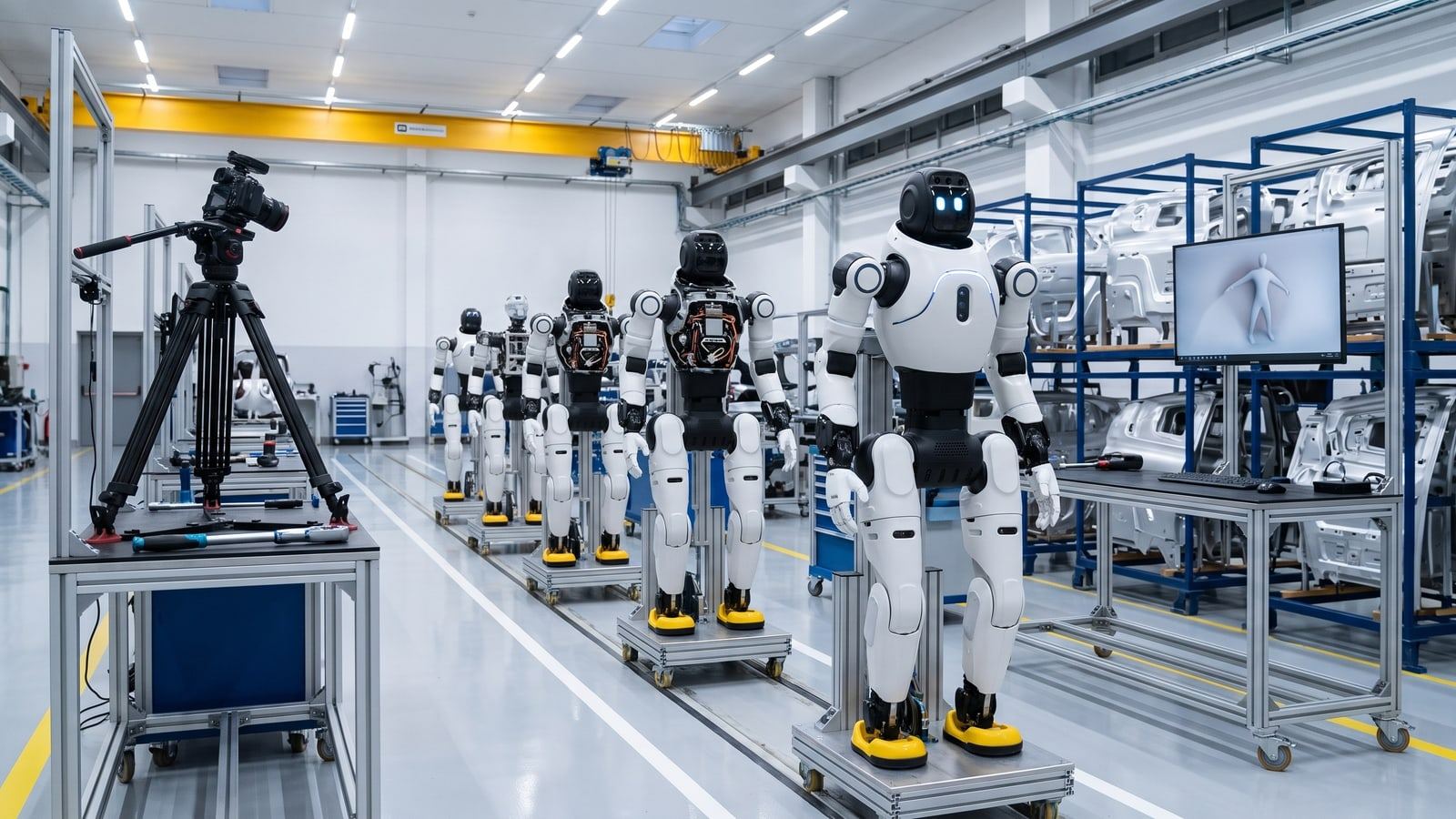
On the last weekend of August, humanoid robots started coming off a production line in Šabac, a town in western Serbia. The Serbian government calls it Europe’s first mass-production base for humanoid robots. The company running it does not make robots for a living. Minth Group makes body panels, aluminium parts and battery casings for cars.
Six days later, in Berlin, the same partnership announced a European safety certificate and a European distributor. Within a single week, Europe acquired the three things a humanoid market needs and had never had together: a factory, a certificate and somebody to sell the machines.
What opened in Šabac
The first phase is a 20 million euro, 3,000 square metre line inside Minth’s existing metal parts plant, where humanoids and robot dogs are assembled, have their motion and vision systems calibrated, and are put through performance tests. President Aleksandar Vučić, who opened it alongside Minth founder Qin Ronghua, said he hoped more than 5,000 robots a year would be assembled there to begin with. The plan behind it is a 200 million euro robotics industrial park in Inđija, north of Belgrade, with a stated capacity of 20,000 humanoids and robot dogs a year for European and world markets.
The robots are AgiBot’s. The Shanghai company built its 10,000th robot in March and its 15,000th in June, and reports commercial deployments across more than 20 enterprises in factories, hospitality and service work. Its A2 model is already rented by the day in several markets.
Then came IFA. At the Berlin trade fair on 4 September, which staged its first robot runway and counted 932 Chinese exhibitors, AgiBot showed its A3 humanoid and X2 Ultra, announced TÜV Rheinland certifications for its machines, and named Tekpoint as its partner for European distribution.
Why it was a car-parts supplier
We argued two weeks ago that the car industry is quietly becoming the robot industry, because building ten thousand identical machines that survive vibration and heat is a manufacturing problem carmakers solved a century ago. Šabac is that argument one level down the supply chain.
Minth is a Hong Kong-listed supplier with around 80 plants and offices in 15 countries and 27,400 employees. It has been in Serbia since 2018, and its two plants there in Loznica and Šabac employ 3,500 people making parts for European carmakers. It did not build a robot factory. It added a robot line to a factory it already ran, with a workforce that already held automotive tolerances and customers already inside the European Union.
That is why this happened in Serbia and not in a robotics cluster. The analyst quoted by Chinese state media put it plainly: Chinese manufacturers already had a mature supply-chain presence in the country, and the Balkans are within reach of the whole European market. A line is faster to add than a plant is to build.
What changes for anyone who wants to own the machines in Europe
For a European fleet, the limit on humanoids this year has been supply, not appetite. Boston Dynamics committed its entire 2026 Atlas production to Hyundai and Google DeepMind. Tesla has sold no Optimus to an outside customer. Figure’s machines went to BMW. A European operator who wanted humanoids in numbers was buying from China, with shipping, import handling and after-sales support all sitting on the far side of a customs border.
A plant in the Balkans with a European distributor and a TÜV certificate does not remove that border, but it shortens the lead time, moves service closer and gives a multi-manufacturer fleet one more serious source to buy from. That matters for the way the beep Robo-Pool is built: across makers and industries, so that no single supplier’s allocation decides what the fleet can deploy.
What is not proven
The first robots off the line wrote calligraphy, folded clothes, played chess and danced. None of that is a shift. The 20,000 a year is a plan for a park that has not been built, and the 5,000 is a president’s hope, not an order book.
The other open question is jurisdiction. Serbia is not in the European Union, though it sits inside its trade orbit, and the machines are designed in Shanghai. We wrote last week that a working robot produces a record of its work, and that the contract decides who owns it. European buyers of Chinese humanoids are now being asked a second question in the same breath: which country’s law reaches into the machine. For a fleet operating in Swiss and EU buildings, that vetting is not optional, and it is one of the things a pooled structure has to do on the owner’s behalf rather than leave to the buyer of a single unit.
Europe spent two years asking whether it would ever build humanoids. The answer turned out to be a car-parts plant in Šabac. The question that replaces it is who gets to own what comes out of it.