
Two weeks ago a Zurich company became Switzerland’s newest unicorn on the strength of a robotics product. It does not manufacture robots. It sells a kit that turns machines other people already bought into robots.
Gravis Robotics raised 200 million dollars from SoftBank on 17 August, the largest Series A in construction robotics so far, at a valuation of one billion. The company spun out of ETH Zurich’s Robotic Systems Lab in 2022, the same lab that produced ANYbotics and its ANYmal inspection robot back in 2016.
What you actually buy from Gravis
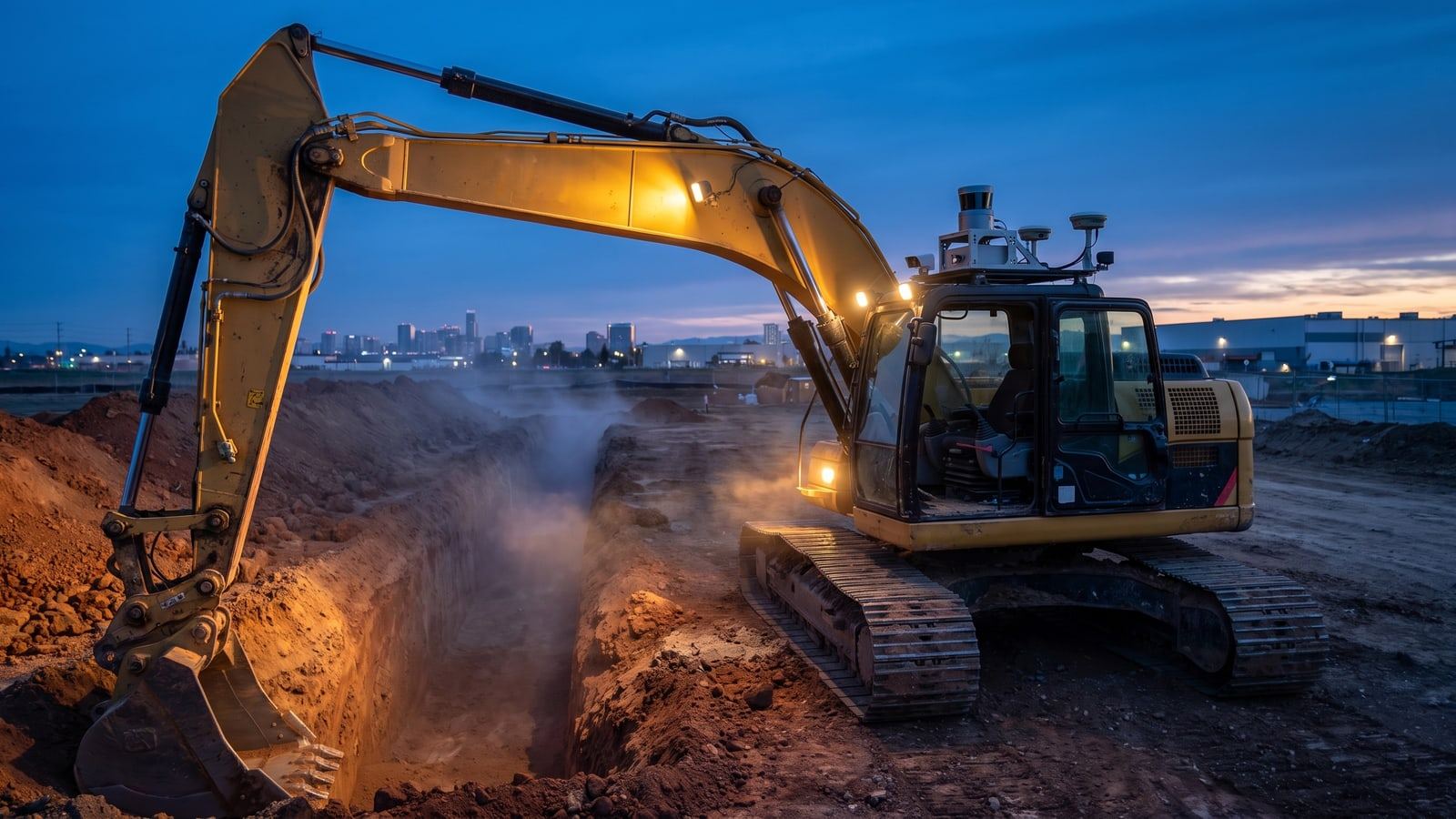
The product is the Gravis Rack, a control kit of sensors and software that mounts on an excavator and lets it dig, level ground and load lorries on its own. It runs on machines from Caterpillar, John Deere, Volvo, JCB, Hitachi, Case, Develon, Sumitomo and Yanmar, in three modes: assisting the operator in the cab, running under remote control, or working with nobody aboard. ETH Zurich says the systems are on dozens of commercial construction sites across four continents.
Look at the shape of that. The robot is not a new machine parked next to the old one. It is the old one, still owned by whoever owned it on Monday, doing more on Friday.
Why that matters to whoever owns the machine
Buy any piece of capital equipment and you accept a curve. The day it arrives is the best it will ever be, and everything after that is wear, depreciation and the slow obsolescence of its specification. You bought the machine and its ceiling in the same transaction.
Retrofits break that assumption. The same steel that earned a manual day rate in 2024 can earn an autonomous one in 2027, without anyone scrapping it or paying for its replacement. That is an unusual kind of asset: one whose capability can be raised long after purchase, for a fraction of what the machine itself cost.
The most interesting name in the announcement is not Gravis
Alongside the funding, Gravis is leading an eight million dollar project backed by the UK government’s CAM Pathfinder programme. Its partner is Flannery Plant Hire, one of Britain’s largest plant hire businesses, and the work is to retrofit a set of excavators for autonomous trenching, bulk excavation and truck loading.
Flannery does not build anything. It owns machines and rents them out by the day to contractors who need them for a job, then takes them back and rents them to somebody else. That business is more than a century old. It has published day rates, utilisation benchmarks, maintenance contracts and a working secondary market, because owning a machine and renting out its hours has always been a legitimate way to earn from capital.
So the first customer for construction autonomy at this scale is not a builder. It is a fleet owner, buying autonomy because it makes the hours it rents out worth more.
The market robots are walking into already exists
The usual objection to treating robots as an ownable, income-producing asset is that no such market exists yet. Plant hire is the counterexample, at scale, in every country with a construction industry. Britain’s national infrastructure pipeline alone now runs to more than 700 billion pounds of planned capital investment across 734 projects, and a large share of the machines that will do that work will be rented rather than owned by the firms using them.
The insurance, the utilisation maths, the service contracts and the customer expectations were all built for machines that happened to have a person in the seat. Take the person out and very little of that has to be reinvented. This is the reason the beep Robo-Pool is built across manufacturers and industries rather than around one platform: the machine is the asset, and the rules for earning from machines are already written.
What has not been proven
The Flannery project is a pilot with a handful of excavators and public money behind it, not a rollout. The 30 percent productivity improvement is Gravis’s own figure, measured against peak manual operation, which is a demanding baseline to hold on a real site with real soil and a real weather forecast.
An autonomous excavator on a public infrastructure job also answers to a heavier regulatory regime than a robot inside a private warehouse. That this arrived as a government pathfinder programme rather than a product launch is the tell: the rules are still being written.
What moved in August is the direction of the question. It is drifting away from whether machines can work without an operator, towards the one that follows: who owns the hours when they do.