
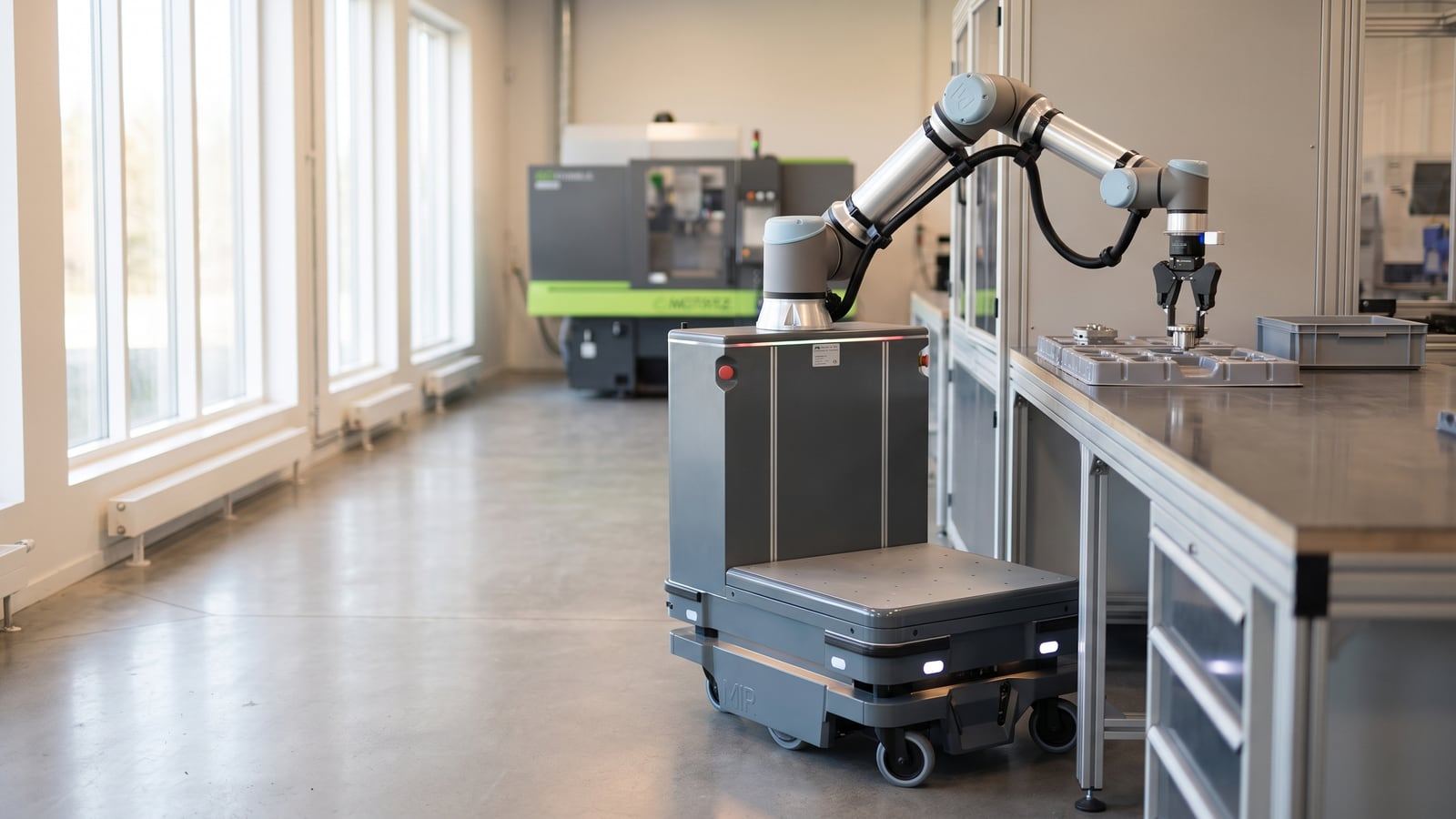
Machines normally lose capability from the day you buy them. A press does what it did on delivery, minus wear. A truck’s job description never changes. Everything mechanical you can own has a fixed list of things it does, and the list only ever gets shorter.
Robots have started behaving differently, and a paper published last week shows how far this has gone.
Twelve seconds to learn a job
On 19 August, the robotics lab Generalist AI released a model called GEN-1.5. Its claim, in the company’s own words, is that the model “learns new tasks in seconds when prompted with 3 to 12 seconds of a single demonstration, no training required”.
Read that again, because the important part is easy to skim past. Not three to twelve seconds of training. Three to twelve seconds of somebody showing the robot the task once. No retraining, no fine-tuning, no engineer rewriting the program. Generalist calls these demonstrations “physical prompts”, and the analogy is to the way you prompt a chatbot instead of retraining it.
The honest numbers are these. Across ten different tasks, one-shot prompting succeeded 59 percent of the time. Give the model five minutes of data and ten gradient steps, and success rises to 83 percent. Fifty-nine percent is not a machine you turn loose on a production line unsupervised. It is also not what a research demo looked like two years ago, when teaching a robot a genuinely new manipulation task meant weeks of data collection and a specialist.
The company reports that abilities it did not train for showed up anyway, including tool use it had not seen and working around obstacles.
Why this changes what a robot is worth
We wrote recently that utilisation, not hardware, decides what a robot fleet earns. A machine earns while it works and costs money while it waits. That framing has a consequence people usually miss.
A single-task robot is only worth as much as its one task. When the contract ends, when the product line changes, when the customer reorganises the warehouse, the machine goes idle and its owner starts looking for another customer with the identical problem. That search is the expensive part.
A robot that can be shown a new task, and be usefully productive at it the same afternoon, does not have that problem in the same way. It fills gaps. It moves between jobs inside the same building. It can take the small contract that was never worth a bespoke integration.
And it does something no other machine you can own does: it gets better while you own it. The hardware you have in January can do things in December that nobody had trained it to do in January, because the model improved, not the motors. Capability arrives as a software release. That is a strange property for a physical asset to have, and it runs in the opposite direction from every other piece of equipment in the economy.
What it means for a mixed fleet
There is a second-order effect worth naming. When capability lives in the model rather than in bespoke per-machine programming, the model is increasingly what determines what a robot can do. Research groups are explicitly working toward models that transfer skills across different robot bodies rather than being welded to one vendor’s hardware.
For anyone holding machines from several manufacturers, that direction is good news. A mixed fleet has always carried an integration penalty, because every vendor needed its own toolchain and its own specialists. The more capability comes from shared models, the smaller that penalty gets. This is one reason the beep Robo-Pool is built across manufacturers and industries instead of standardising on a single platform: we would rather hold the machines that have work than be locked into whichever vendor looked strongest at purchase time.
The market is moving in the same direction. Counterpoint Research counts more than 22,000 humanoid robots shipped worldwide in the first half of 2026, close to 300 percent up year on year, and projects more than 50,000 units for the full year. Those machines will not be reprogrammed one at a time by hand.
The part that is still hard
Research results are not deployments. GEN-1.5 is a laboratory result on ten tasks, not a fleet running unattended in somebody’s warehouse, and the gap between those two things has swallowed a lot of robotics companies. A model that succeeds 59 percent of the time on the first try still needs a human in the loop for anything that matters. Reliability, safety certification and the unglamorous work of integration remain exactly as hard as they were.
We do not guarantee returns, and no model release changes that.
But the direction is worth understanding, because it quietly rewrites what owning a robot means. For a century, owning a machine meant owning a fixed capability that decayed. Owning one now means holding a piece of hardware whose job description is still being written, by people who have never seen your machine, and who ship their improvements to it while it works.