
Every price list for robots shows two numbers: what a machine costs to buy and, sometimes, what it rents for. Neither shows the number that decides what it actually earns, which is how long it takes between the machine arriving at a site and the first hour anyone pays for.
On 1 October a Zurich company said it had cut that period from weeks to days. How it did that says more about owning robots than most of this year’s hardware launches.
What ANYbotics announced
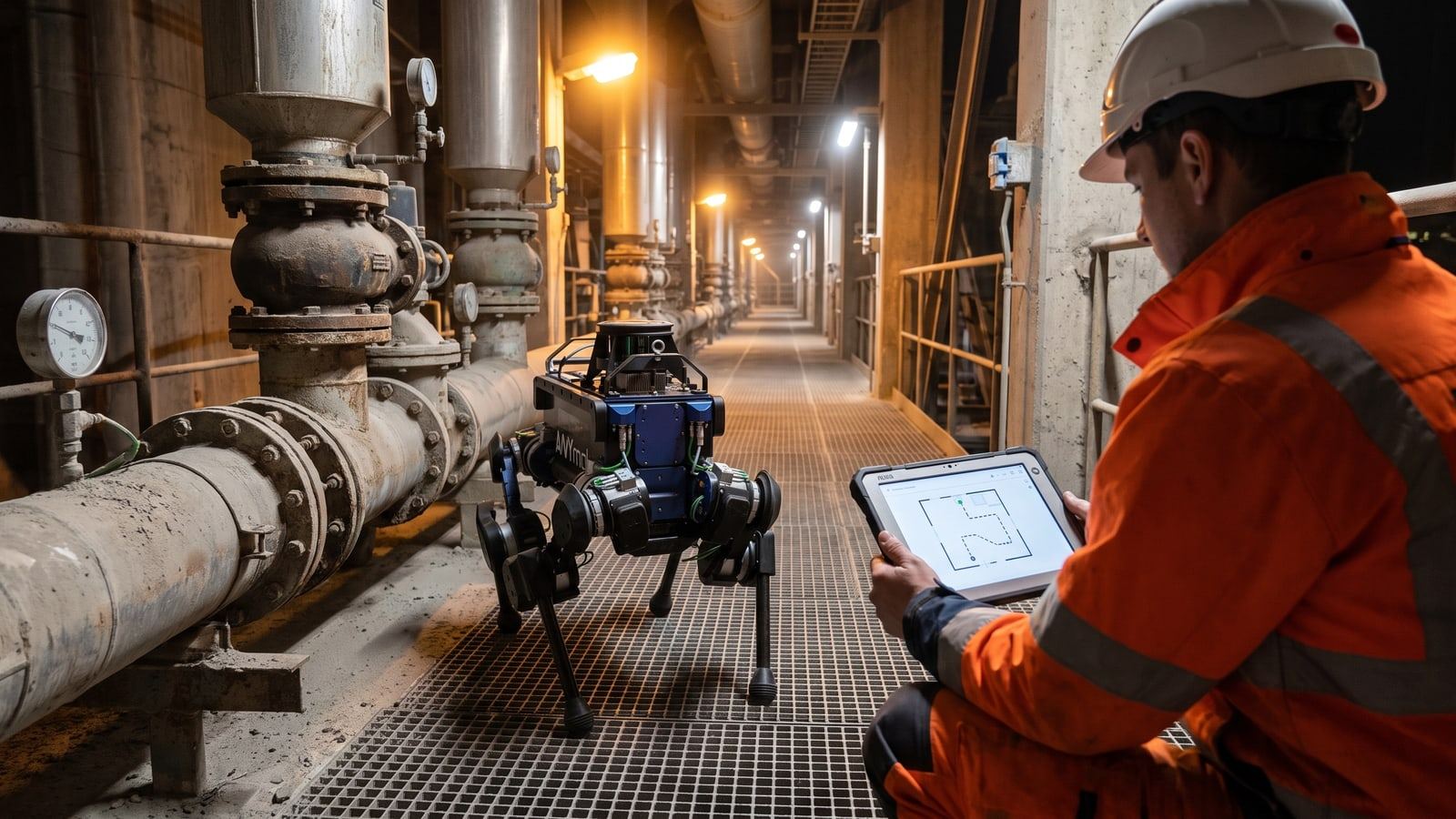
ANYbotics, the ETH Zurich spin-off that builds the ANYmal four-legged inspection robot, came out of the same lab as the excavator-autonomy company Gravis. It has launched a platform called Shift that connects a plant’s digital model, the robot fleet, the inspection data and the customer’s maintenance systems in one workflow, so a reading the robot takes on its rounds can turn straight into a work order.
The sentence that matters for owners is a smaller one in the announcement. ANYbotics says setup work that used to need its specialists for weeks can now be done by the customer’s local technicians in days.
The company reports more than 200 robot deployments across energy, metals, mining and chemicals. One customer, Vigier Cement, has run more than 33,000 autonomous inspections in 16 months on round-the-clock operations.
The dead time nobody prices
Every robot has a stretch when it is on site and earning nothing. The site has to be mapped, routes taught, missions defined, the robot connected to the customer’s systems and the staff shown what it does. For a machine that stays at one plant for years, that is a one-off cost, forgotten by the second quarter.
A rented machine does not stay forever. Contracts end, customers change, demand moves from one industry to another, and every move starts the dead time again. When the setup needs a specialist from the maker, it costs twice: the specialist’s days, and the weeks in which the machine bills nothing.
Why this matters more to an owner than to a buyer
A buyer who keeps a robot at one plant pays for setup once. An owner who rents machines out pays for it every time a machine changes hands. Over a working life, the number of moves multiplied by the dead time per move comes straight off the hours a machine can bill.
We have written before that a fleet does not buy capability, it buys utilisation, which is capability with a customer attached. Setup time is where utilisation leaks away quietly, in the gaps between customers rather than on the job. Cutting it from weeks to days, and turning it into work a local technician can do, changes the economics of a machine’s whole life rather than just its first month.
The software is separating from the hardware
The other half of the announcement points the same way. ANYbotics plans to open Shift to other makers’ robots: data from third-party sensors and robots from this month, and management of third-party fleets next year.
The same week, Primech, a Singapore facilities-services company listed on Nasdaq, showed a platform that puts its delivery, reception and cleaning robots on the same screen as its human staff. Its chief executive, Ken Ho, said the company’s grounding in facilities management is what tells it where robots are worth deploying.
Last week we described how Tesla plans to keep its humanoids, their data and their operation inside one company. In inspection and facilities the opposite is happening. The layer that schedules, monitors and redeploys robots is becoming a product of its own, and it is starting to work across makers. For a pool built across manufacturers, like the beep Robo-Pool, that is a precondition: a mixed fleet is only manageable if the software that runs it does not care who built each machine.
What is not proven
“Weeks to days” is ANYbotics’ own claim, with no published breakdown of which tasks or which kinds of plant. Inspection is also a forgiving case for setup, because the robots walk fixed routes in plants that change slowly, while a warehouse or a hospital changes every day. Managing other makers’ fleets is a plan for next year rather than a product, and Primech’s customer demonstrations have only just begun, with no deployments disclosed.
The price of a robot gets the headlines. The time it takes to get one working, and to get it working again somewhere else, decides what it earns.