
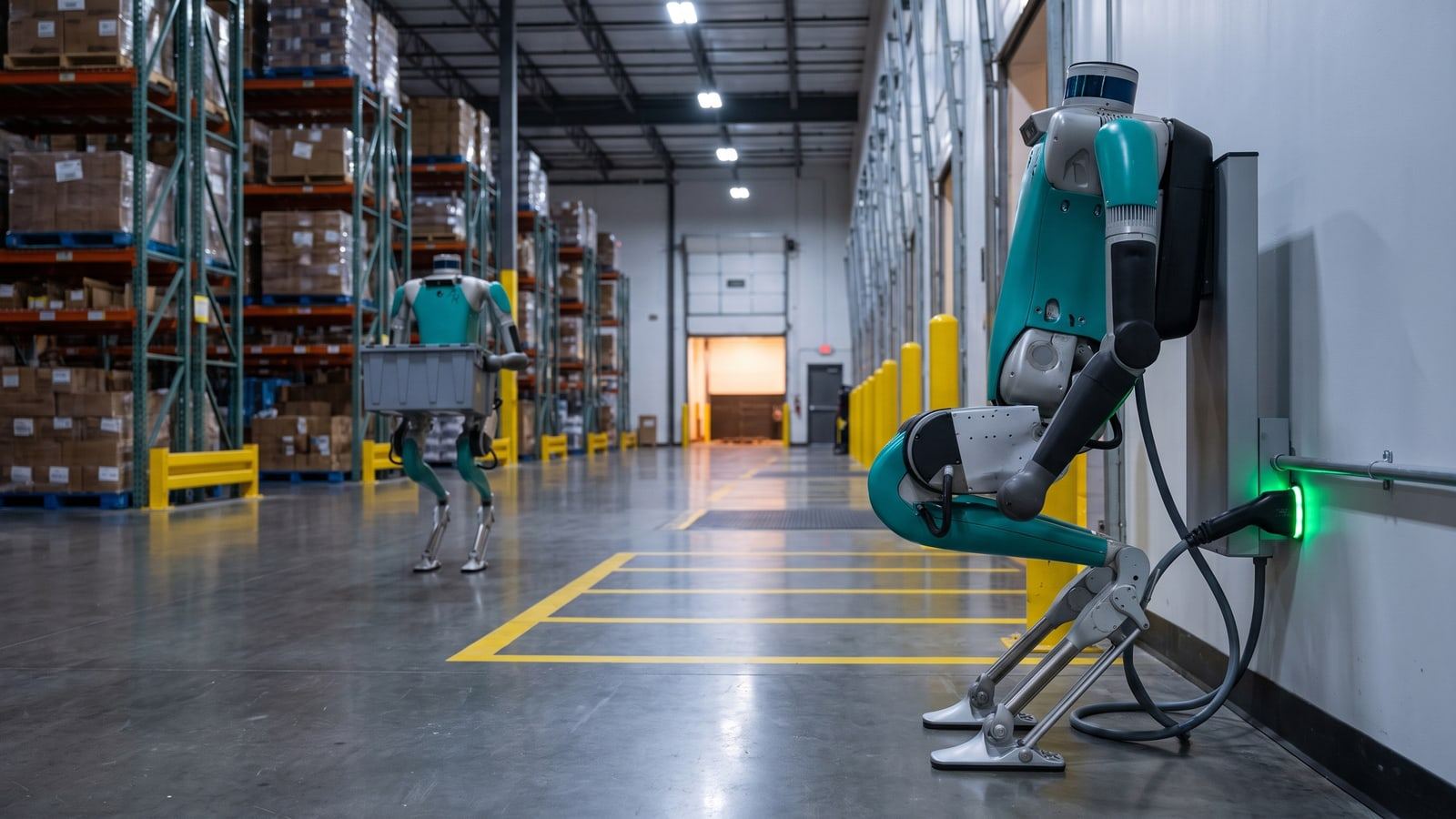
A robot’s spec sheet lists its runtime. The number an owner needs is a different one: how much of the day the machine spends on the charger. Those are hours that cost money and earn nothing.
On 15 October Agility Robotics put a figure on it. Its next humanoid, Digit 5, will get a battery that runs for 90 minutes and recharges in nine, a run-to-charge ratio of ten to one. The current Digit manages two to one. Agility says the new pack lets the robot work more than 20 hours in a 24-hour day, which it describes as more than two full shifts.
“For our customers, Digit’s uptime is the business case,” said Daniel Diez, Agility’s chief business officer.
Who makes the battery
The cells come from Nyobolt, a company that grew out of battery research at the University of Cambridge in 2019. Its cells use anodes made of niobium tungsten oxide, a material that lets lithium ions move fast enough to fill a cell in minutes rather than hours. In May Nyobolt raised 60 million dollars at a valuation of one billion, in a round led by Symbotic, whose warehouse robots already run on its batteries. Its chief executive, Sai Shivareddy, said the technology was chosen because Digit 5 needs more power from a smaller, lighter pack.
The arithmetic of a working day
At two to one, a robot spends a third of its time charging. Over 24 hours that leaves at most 16 working hours, before any maintenance or breakdowns. At ten to one, charging takes less than a tenth of the day, and Agility’s own estimate of more than 20 working hours follows from it. The same machine, bought once, sells about a quarter more hours every day.
The effect is larger across a fleet. Keeping one position staffed around the clock with robots that work two hours and charge for one takes one and a half robots, because each is available only two thirds of the time. A warehouse that wants ten positions covered day and night needs fifteen robots at the old ratio and about eleven at the new one. On paper, four machines’ worth of capital stops standing next to a socket.
That is the part of the announcement that matters to an owner. A robot’s purchase price is spread over the hours it works. Every hour on the charger carries its share of that price and returns nothing. We wrote recently about the weeks a robot can stand idle between customers while it is set up again. Charging is the same leak at the scale of a single day, repeated every day of the machine’s life.
Charging fast or swapping packs
Agility is not the only maker attacking the problem. UBTech’s Walker S2, shown in 2025, swaps its own battery in about three minutes and carries two packs so it can keep working while one is replaced. Both routes aim at the same thing, a robot that never stops for long, and they cost an owner differently. Swapping needs spare packs, which is extra hardware bought up front and kept charged. Fast charging needs high-power chargers and cells that can take many charges a day for years.
Which brings up the number neither company has published. A robot that works for 90 minutes and then charges for nine goes through more than a dozen charging sessions in a single day. How many charge cycles the pack survives before it loses capacity decides when it has to be replaced, and a battery replacement is a maintenance cost that lands on whoever owns the machine. How easily a robot can be serviced is part of what it is worth. So is the life of its battery.
What it means for owning robots
For a pool that owns machines from several makers, like the beep Robo-Pool, the useful question to ask a maker is not how long the battery lasts. It is how many hours a day the machine can be put to work, and what it costs to keep it that way over its life. Agility has now answered the first half in public. The rental rates in our catalogue are quoted by the month. The working hours inside each month are what decide whether a machine pays for itself.
What is not proven
Every figure here comes from Agility or Nyobolt. Neither has published the battery’s capacity or its cycle life, and runtime will vary with the load the robot carries and the temperature it works in. Digit 5 reaches early customers in the first half of 2027, so for now this is a specification rather than a track record. The announcement also comes while Agility’s stock-market listing is still pending, a moment when any company has reason to make its next product sound ready.
What changed this month is that a humanoid maker chose to compete on the share of the day its robot can work. That is the number owners should have been asking for all along.