
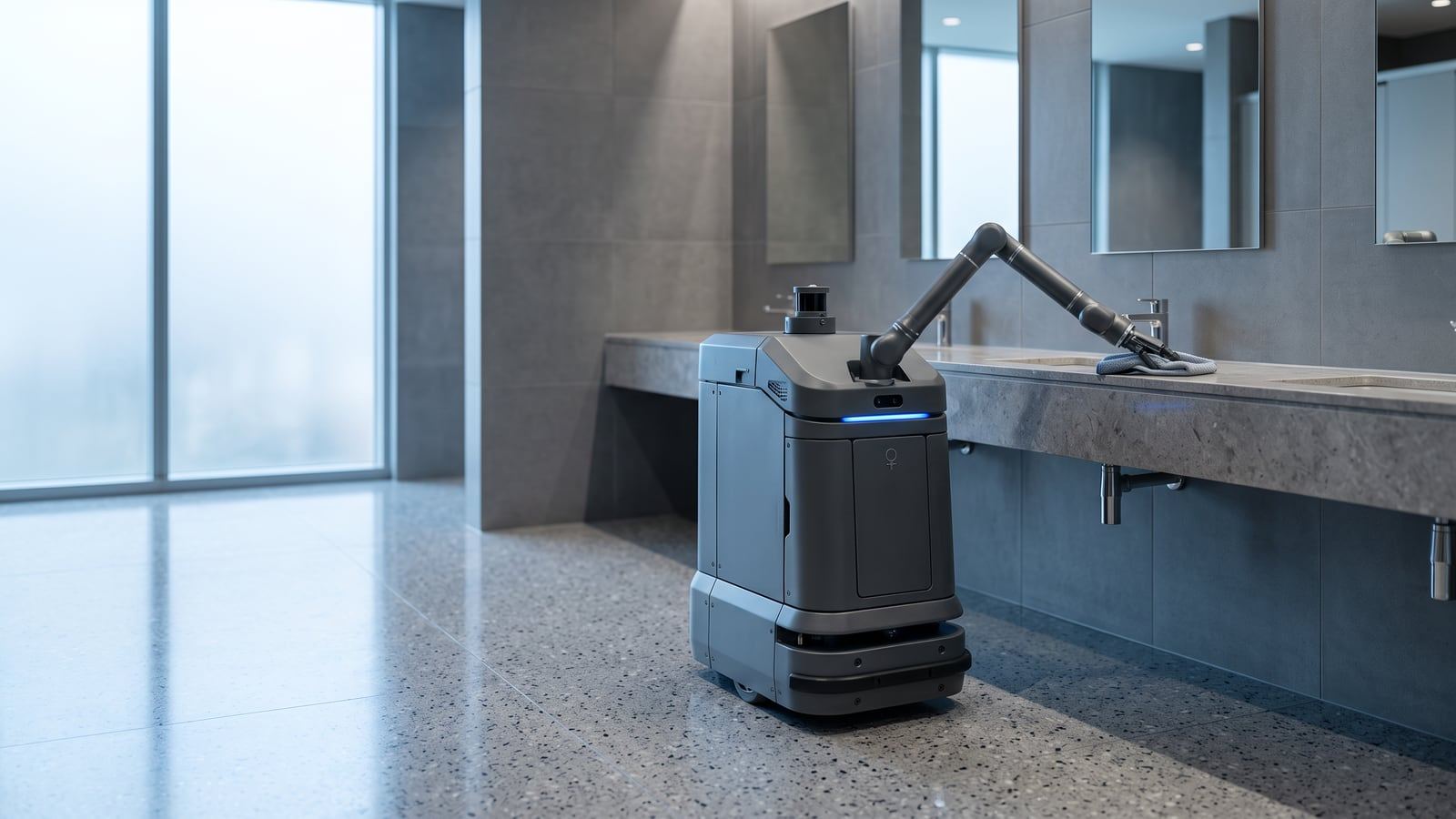
The clip above is 66 seconds of a robot cleaning a public restroom. It washes the basins, wipes the surfaces, works the floor. There is no music swell and nothing acrobatic. It is the least impressive robot video we have linked to, and it may be the most important one.
The machine is called LOKI, and the company behind it is not in Shenzhen or Silicon Valley. Loki Robotics is based in Zurich, about half an hour from our office in Zug. It was founded by Miks Ozols and Antonio Arbues, and in May 2025 it raised 1.6 million dollars in a pre-seed round led by byFounders. Its robot swaps tools, applies cleaning agents with some precision and physically handles fixtures, which is harder than pushing a scrubber across a lobby floor.
On its own channels the company says the robots run eight-hour shifts, day in and day out, and that units are already working in facility-management jobs in data centres, offices and campuses on several continents. Those are the company’s figures rather than audited numbers, and worth reading as such. But the claim being made is notable for how modest it is. Nobody is promising general intelligence. They are promising a shift.
Yesterday we wrote that a dancing humanoid proves capability but not demand, and that the machine with a payer attached is the one that behaves like an asset. This is that machine. Cleaning is the case in point: byFounders puts the global cleaning market at more than 350 billion dollars and notes that the work is repetitive and still done almost entirely by hand. There is no shortage of demand for someone to scrub a restroom at six in the morning.
It is also the clearest illustration of how automation actually arrives. Not through the jobs people write essays about, but through the ones nobody wants and everybody needs. A robot that cleans toilets in Zurich at dawn is not a story about the future of intelligence. It is a story about a shift being covered, every day, by a machine that somebody owns.