
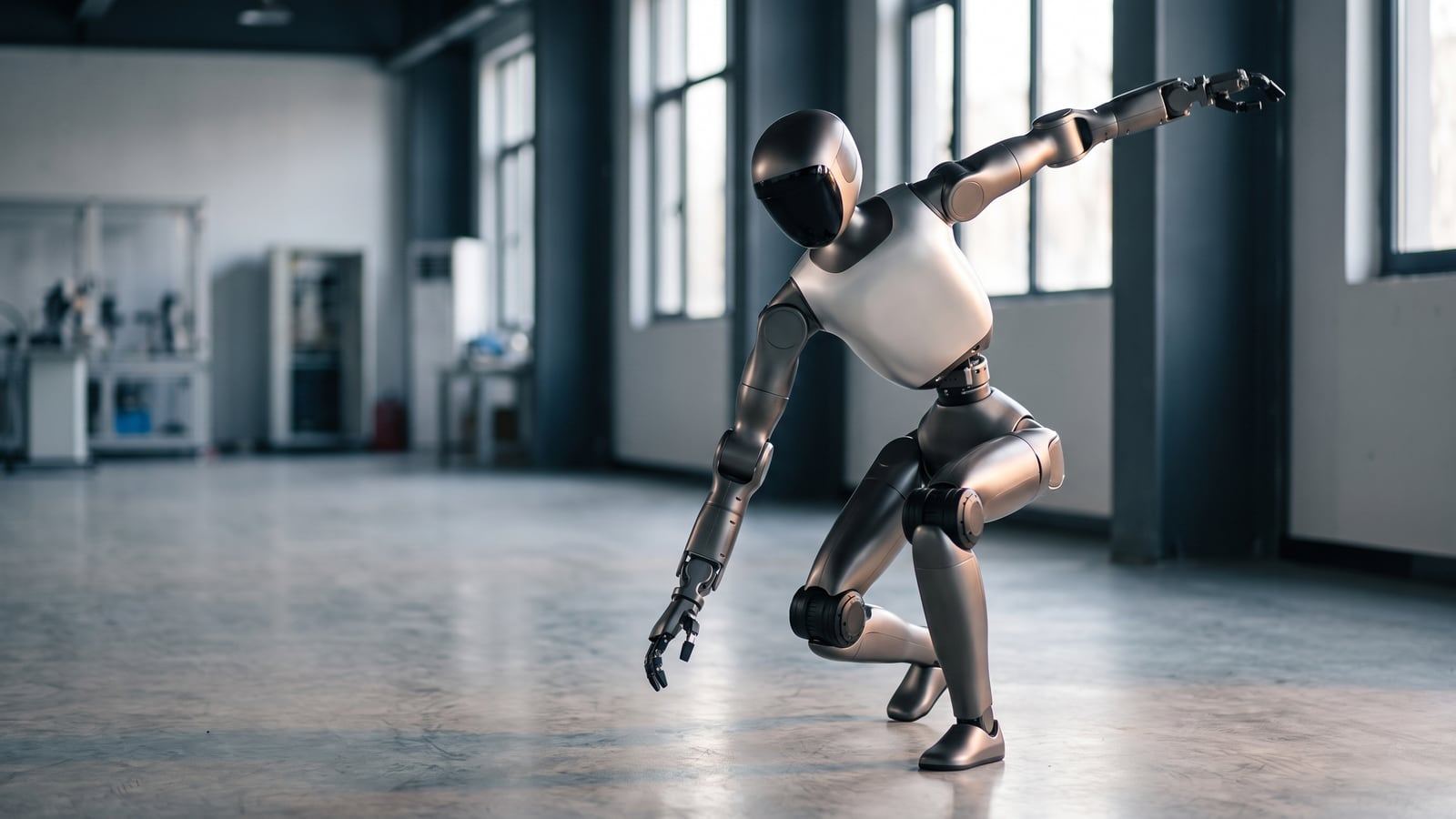
The clip above is 112 seconds of a humanoid robot dancing. It went up on 13 August on the German channel tuningblog, which credits the footage to the manufacturer, Booster Robotics. Somewhere in it the machine drops toward the floor, puts its weight on one arm and comes back up.
Videos like this arrive every few weeks now, and the usual reaction splits into two camps. One says the robots are here. The other says it is a party trick. Both are wrong in a way that matters if you are thinking about robots as an asset rather than as entertainment.
Dancing is a real test
It helps to know what the machine is. According to the Booster T2 spec listing, it stands 140 centimetres, weighs 43 kilograms, has 31 degrees of freedom with twelve more in the hands, walks at 5 km/h, carries 10 kilograms and runs about two hours on a charge. The listed price is 45,000 dollars.
Now consider what the dance demands of that hardware. The robot has to know where its centre of mass is at every instant and keep it over a support area that keeps changing shape. It has to produce torque fast enough to catch itself, and joints that survive being loaded and unloaded hundreds of times without drifting out of calibration. Putting its full weight on one arm means the arm joints are structural, not decorative.
None of that is faked in post-production. Balance under changing contact is the same problem a robot faces carrying a tray across a floor with a wet patch on it, or lifting a box that turns out heavier than the label said. Engineers use dance for demos because it exercises the whole control stack at once and because it looks good. The first reason is legitimate.
Dancing is also not work
Here is the part the enthusiastic camp skips. Nobody pays for dancing.
Last week we published the rental price list for working robots. A serving robot goes for 300 to 500 dollars a month, a cleaning machine for 400 to 3,500, a warehouse unit for 1,500 to 3,000. Every one of those machines is duller than the T2 by a wide margin. Every one of them has a customer, a contract and a monthly invoice.
A demo proves capability. A contract proves demand. They are different claims, and the distance between them is measured in things the video cannot show: how often the machine fails in a week of real shifts, how long a repair takes, who pays while it is down, whether an untrained employee can operate it, whether it still works on a floor nobody mopped.
That gap is why a 45,000 dollar robot that dances can be worth less as an asset than a 400 dollar a month robot that carries plates. Not less impressive. Less valuable, today, because the second one has a payer attached.
Why we still watch these videos closely
Because the gap closes, and this is what the sceptics get wrong.
Every capability in the clip started as a research demo and moved into products on a fairly reliable schedule. Balance control that looked spectacular on a lab video five years ago is now the baseline expectation for a warehouse machine that has to work near people. The dance is a preview of what ordinary machines will do routinely once the cost of that control drops, and control gets cheap the way software gets cheap.
The T2 also carries what its listing calls a Thor compute platform, which is the same class of onboard hardware showing up across the category this year. That is the actual story in these videos: not the choreography, but that a 43 kilogram machine now has enough compute on board to run this kind of control in real time, and that you can buy one.
What this means for a fleet
A robot fleet does not buy capability. It buys utilisation, which is capability with a customer attached.
This is why the beep Robo-Pool holds machines across manufacturers and industries rather than betting on the most advanced platform available. The impressive machine and the profitable machine are frequently not the same machine, and the ranking between them changes faster than any single purchase decision can track. A pool buys the ones with contracts, and it can keep buying as the dancing category becomes the working category.
We do not guarantee returns, and a spec sheet is not a business case. A robot that can dance may never earn a franc, and plenty of capable machines never find a market.
But the clip above is not science fiction and it is not a trick. It is a 45,000 dollar product, in production, doing something that would have been a research paper a few years ago. The question worth asking about it is not whether it is impressive. It is who will be collecting the invoices when machines like it stop dancing and start working.