
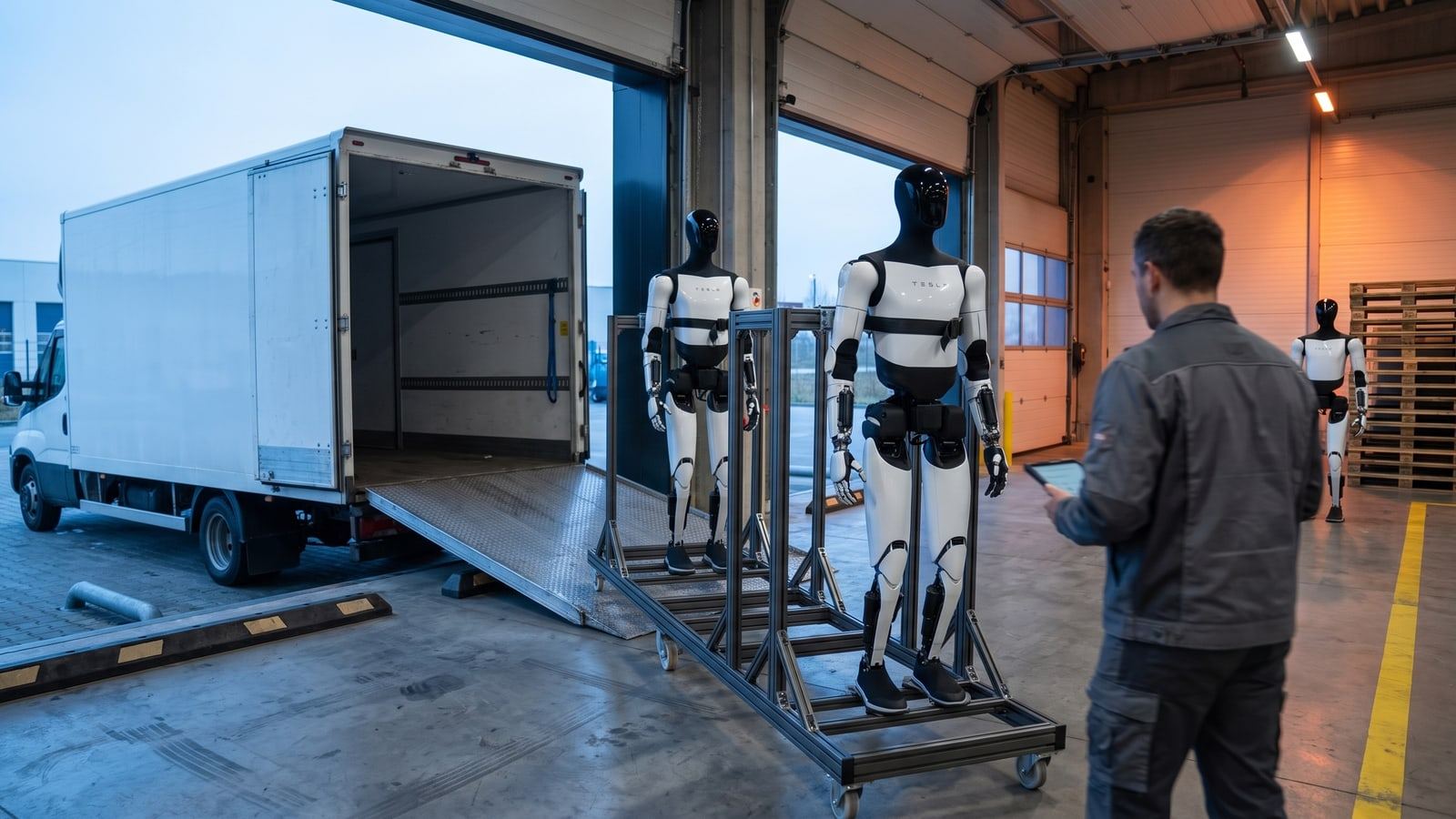
Most of the coverage of Tesla’s robot this week was about hands. A report by The Information, summarised by Electrek, said the Fremont line went from a few dozen Optimus units a week in the second quarter to several hundred a week in August, that the hand and forearm still contain over 100 screws and small parts fitted by hand, and that the robot still needs several days to learn even basic tasks.
The sentence that matters more for anyone who wants to own robots came further down. Tesla, the report says, intends to lease Optimus, not sell it, to a short list of companies whose factories and warehouses look like its own.
Why a maker rents out a young machine
The reasons are all in the same report, and none of them is unusual.
The robot is not general yet. A machine that takes days to learn a basic task works best where the environment resembles the one it was trained in. Leasing lets Tesla choose those sites, and take the robots back from the ones that do not work out.
The data comes home. Tesla wants to use what the robots record in customers’ buildings to improve its AI; Electrek called it the playbook Tesla used for driver assistance in its cars, ship the hardware and collect the fleet data. A leased robot stays Tesla’s, and so does the stream of data it produces. We wrote this month that a working robot makes two products, the work and the record of the work. Tesla’s structure keeps both.
The hardware is still changing. The hands are assembled manually, some touch sensors have been unreliable, and Tesla plans a replaceable sensing glove next year. A lessor can refit a whole fleet as parts improve. A buyer would own a machine whose next revision was already announced. Serviceability, not only capability, decides what a humanoid is worth over its life.
This has happened before
Until 1956 IBM generally refused to sell its machines. It leased them, and customers paid rent to use equipment IBM owned, serviced and eventually replaced. That ended when a consent decree settling an antitrust case required IBM to offer its machines for sale as well as for lease.
What followed is the part worth remembering. Writing in Reason in 1974, Sara Baase described over a hundred firms whose sole business was leasing IBM computers. They bought from IBM, depreciated the machines over a longer lifetime, and charged lower rental fees. A new kind of company had appeared between the maker and the user: the owner.
Aviation reached the same place by a different road. Airbus and Boeing build aircraft, airlines fly them, and today approximately half of the world’s commercial aircraft fleet is leased, largely from lessors that neither build nor fly them.
Making machines and owning them are different businesses
The pattern is not that makers are wrong to lease. Early on they have to: only the maker can support an immature machine, and only the maker learns from where it fails. The pattern is that making and owning are different businesses, with different capital, different time horizons and different skills, and that once a machine is reliable enough to run at sites the maker does not control, ownership tends to move to people whose whole job is owning.
The IBM lessors’ edge is the detail to hold on to. They were willing to keep a machine longer than the maker assumed it would stay useful, and to price it for that whole life. That is a bet on hours rather than on hardware, and it is the bet at the centre of the beep Robo-Pool: machines from several makers, placed with paying customers, owned for their working life by the people who put up the capital.
What Tesla’s choice tells an owner
Tesla leasing Optimus is the clearest signal yet about where the money in humanoids is expected to be. Not in the sale, which happens once, but in the hours, which are billed every month the machine works. It is also a reminder that at this stage the maker wants to keep those hours to itself.
For a private owner, the realistic question is no longer whether renting wins. Tesla has just answered that for its own robots. The question is who ends up on the owning side of the lease once machines like Optimus can leave supervised areas, and on what terms. Our table of published rental rates shows the machines where that has already happened.
What is not proven
The Information’s report is paywalled and Tesla has not confirmed the plan. Tesla has the balance sheet to keep a large fleet on its own books for years, and nothing forces it to open ownership the way a court forced IBM. Aircraft became a leasing market because they are standardised, certified and easy to move between operators, and humanoids are none of those things yet.
History does not say that third-party ownership of humanoids arrives soon. It says that in comparable machine categories it arrived once the machines had matured, and that when it did, it became a business of its own.