
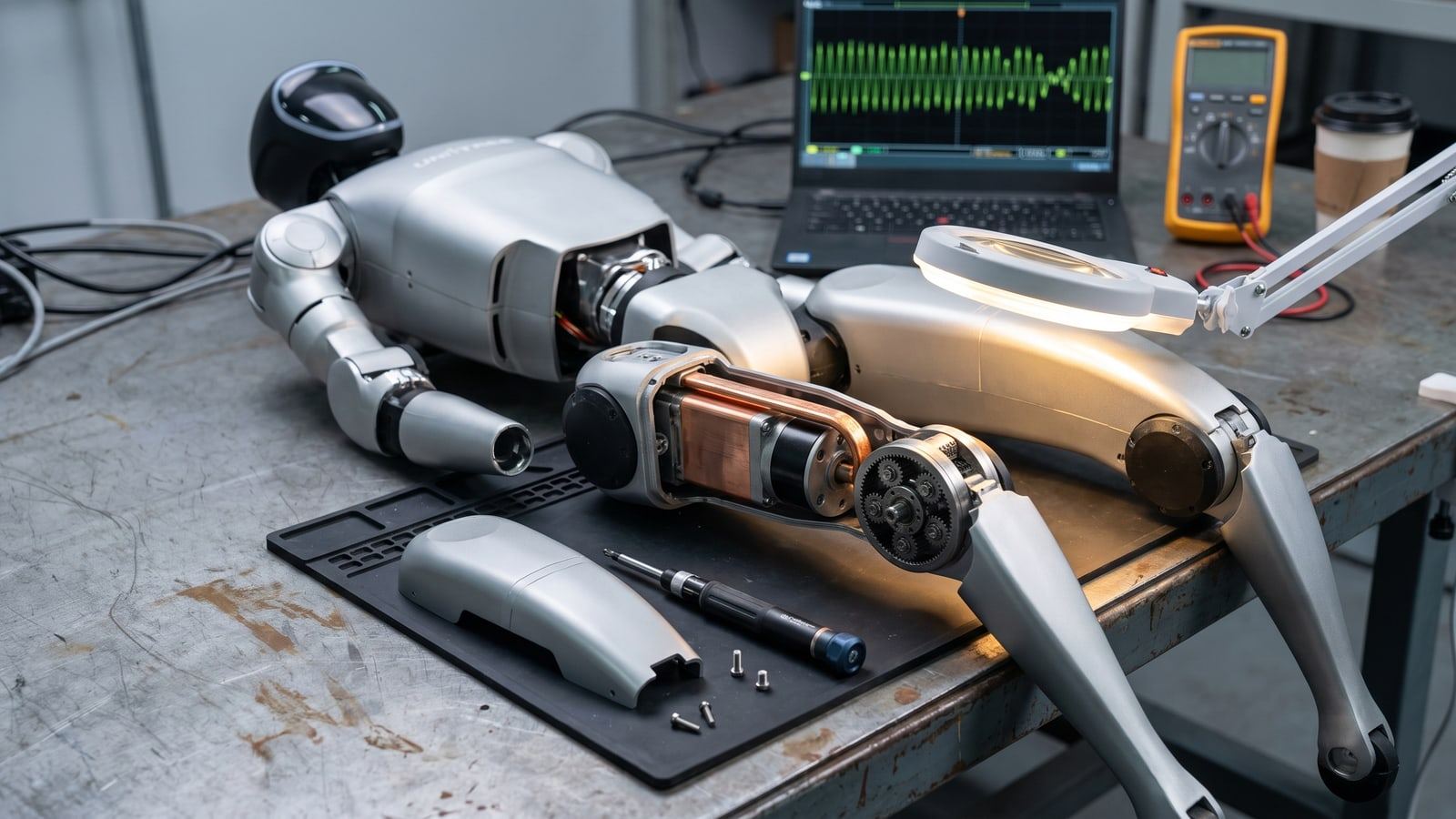
Two things happened this week that had nothing to do with each other and everything to do with the same question. An automotive engineering firm took apart the best-selling humanoid robot on camera. And a Tokyo company put a spare humanoid in a van, painted it like an ambulance, and started driving it to customers whose robots had stopped working.
The question both of them answer is the one that decides whether a robot is an asset or an expense: what does it take to keep the thing running?
What Munro found inside the G1
Munro & Associates has spent years pulling apart electric cars for a living. On 13 September its media arm published a 38-minute examination of the Unitree G1, the compact humanoid that sells direct for the price of a used car, with Scott Walter of Robo Strategy and engineers from Schaeffler at the bench.
The joints are rotary actuators with a two-stage planetary gearbox at roughly 15 to 1, not the strain-wave gearing at 100 to 1 or more that industrial arms use. The motors are, in Munro’s words, relatively inexpensive and less torque dense than the permanent-magnet machines used in industry. The upside of that choice is that the joints are easily back-drivable and the motor current gives a usable reading of torque, which is what lets a machine like this fall over without destroying itself.
The cooling surprised the panel. In the high-duty joints such as the knees, Unitree presses a copper heat pipe directly against the motor stator, a trick borrowed from laptop processors that none of the engineers had seen applied to a motor before. Aluminium housings clamp the motors and carry heat into the structure; two centrifugal fans move air through machined channels in the hips.
Then the compromises. The structural parts are machined from aluminium billet rather than cast, which is fast to change and slow to make at volume. Capacitor boards are scattered through the body to smooth the DC bus, each one adding cables and connectors. The ankle motors sit above the joint and drive it through tie rods, and one greased Cardan joint is left exposed, where dust and grit on a real floor will find it. Munro’s summary was that the design shows a company that put getting working hardware into developers’ hands ahead of optimising any part for production.
Why a teardown matters more to an owner than to a buyer
For someone buying a G1 to experiment with, this is interesting. For someone who owns robots that have to earn, it is the maintenance budget in disguise.
Back-drivable planetary actuators with cheap motors tolerate abuse and are inexpensive to replace: good for a fleet. Billet-machined parts mean expensive spares and a supply chain that does not scale until somebody starts casting them. An exposed greased joint on a machine that works in warehouses and kitchens means service intervals, not just a design note. And every extra connector is a place a fleet technician will one day be looking for an intermittent fault.
None of that changes what the robot can do. All of it changes what it costs to keep doing it, which is the number that turns a rental rate into an income.
The van with the spare robot
The second story came from GMO AI & Robotics, part of Japan’s GMO Internet Group, which deploys humanoids for customers. It has fitted out a van as a mobile workshop: engineers, parts, tools, laptops and, in the back, a replacement humanoid. Purple roof lights and ambulance markings, because the company wanted customers to understand at a glance what the vehicle is for.
The service model is the interesting part. When a robot fails on site, the van brings a replacement, swaps it in, and takes the damaged unit back to a repair base if it cannot be fixed on the spot. GMO says it built the service after its own deployments were disrupted by robots that had to be sent away for repair. There is one vehicle so far, based at the company’s Tokyo headquarters, with more promised if demand appears.
Car-rental and construction-equipment fleets learned this decades ago: the customer is not buying a repair, the customer is buying continuity. The unit of service is the swap, and the thing that makes swaps possible is a pool of spares that belongs to the operator, not to any one customer.
The number that is missing from both stories
Neither Munro nor GMO published a cost. That is not an oversight; it is the state of the industry. Nobody yet prices the service layer of a humanoid fleet in public, and for an owner the service layer is where the return actually lives.
Three figures decide it. How long a machine runs between failures. How many spare units a fleet needs per hundred placed with customers. And how fast a failed unit is swapped, because every hour it stands still is an hour the customer is not paying for. A pool that runs many machines across many sites can carry spares the way a hire fleet does, shared rather than one per customer, which is one of the few places where scale in robot ownership is an advantage rather than a slogan.
What is not proven
A 38-minute look at one machine is not a reliability study, and the G1 is a developer platform; the industrial humanoids built for factory shifts may be engineered differently, and we do not yet have a teardown of one. GMO’s ambulance is a single van in a single city, with no published response times, prices or fleet size. Both are first data points, not curves.
But they point the same way. The teardown tells you what a robot is made of. The ambulance tells you what it takes to keep it working. An owner needs both, and this was the first week anyone showed either in public.