
A first order tells you a customer is curious. A second, larger one tells you the first one worked. Of all the evidence a robot maker can show, a repeat order is the hardest to fake, because somebody inside the customer had to look at the results and sign again.
On 20 October Gecko Robotics, a Pittsburgh company whose robots inspect steel, said the US Navy was raising the ceiling on its contract from 71 million to 300 million dollars. The original contract had been signed seven months earlier.
What the Navy bought in March
On 17 March the Navy and the General Services Administration awarded Gecko a five-year contract with a ceiling of 71 million dollars. The first order, worth up to 54 million, covered 18 ships in the Pacific Fleet: destroyers, amphibious warships and littoral combat ships. The Navy is not buying robots. It is buying inspections, carried out by Gecko’s machines and engineers.
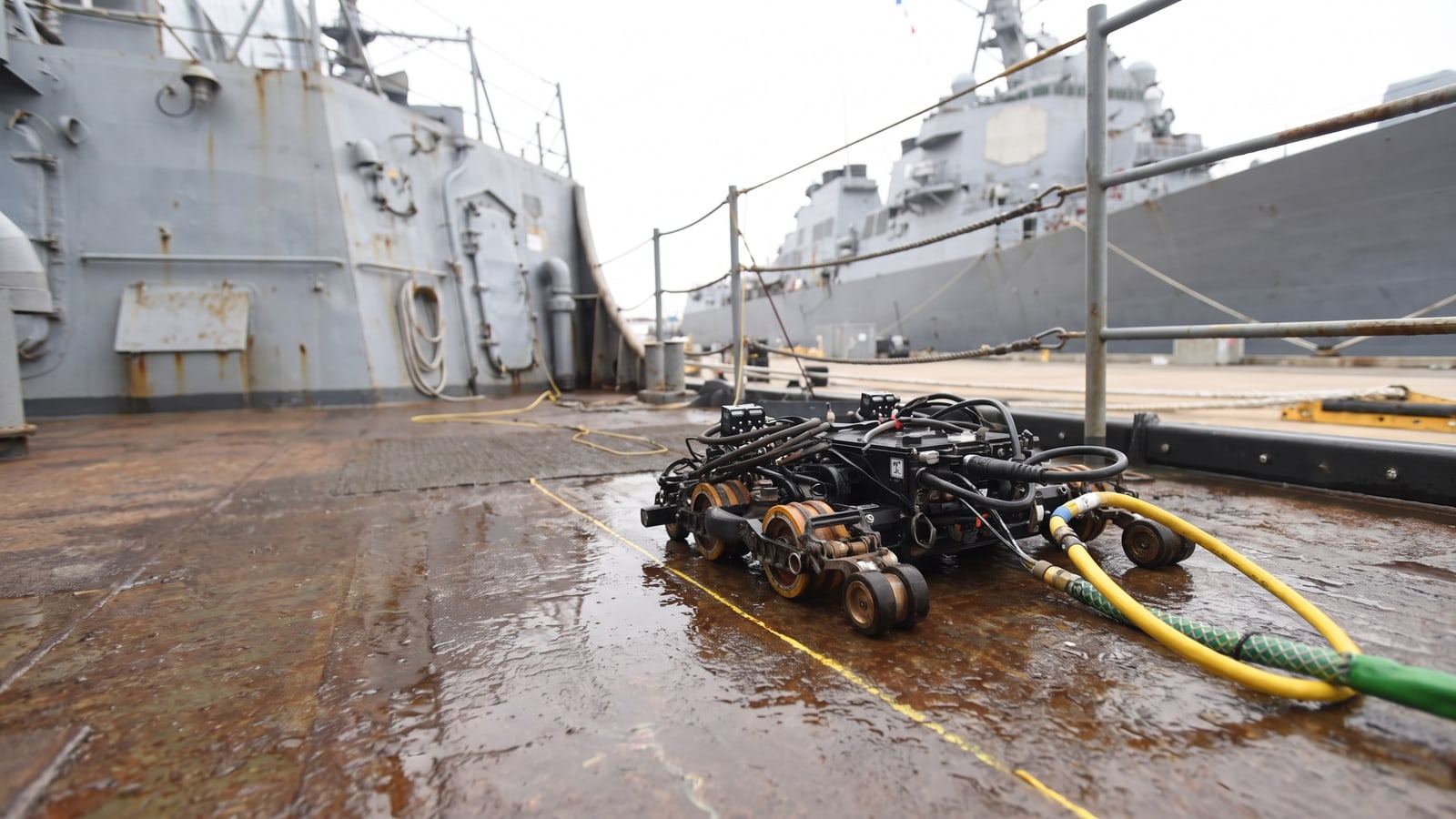
The robots climb. Gecko’s crawlers hold onto steel with magnetic wheels and measure by ultrasound how much metal is left. Its Komodo system, according to the company, measures corrosion and steel thickness beneath the nonskid coating of a deck without removing it. Software then turns the readings into a map of corrosion across the ship, so engineers can plan repairs before it goes into dry dock.
“Readiness isn’t just a metric, it’s all that matters,” said Jake Loosararian, Gecko’s co-founder and chief executive, when the contract was announced.
None of this started with a contract. In August 2022 the Navy tested Gecko’s Toka 4 crawler on the deck of its Self Defense Test Ship at Port Hueneme, California, as one of 65 technologies chosen for a repair exercise.
What changed in October
According to Tectonic Defense, the Navy’s Pacific surface force had already used up the 71 million dollar ceiling, and the new one makes room for its Atlantic counterpart, known as SURFLANT. “In order to be able to accommodate SURFLANT, the contract grew to the $300M to address those additional ships,” said Troy Demmer, Gecko’s president and co-founder. “It’s proven itself that this is something that the entire fleet should be able to leverage.” Demmer expects to roughly double the volume over the next year, to about 40 ships.
Gecko’s spokesman, Steve Bourner, told Stars and Stripes that the higher ceiling lets the Navy order more inspections without setting up a new contract each time. That detail says more than the headline figure. A buyer who removes the paperwork between orders expects to keep ordering.
What the robot is selling
What Gecko sells is not robot time. It is the repair that turns out not to be needed. The company’s clearest example, given to Stars and Stripes, compares two destroyers it did not name. On the first, inspected the conventional way, collecting about 3,000 data points took weeks, and engineers ordered a 7.9 million dollar replacement of the flight deck that added several months to the ship’s maintenance. On the second, Gecko’s robots collected more than 8 million data points, the estimated repair came to 427,000 dollars, and the ship finished maintenance on schedule.
Days in the yard are the currency the Navy cares about. Under Admiral Daryl Caudle, the chief of naval operations, it has kept the goal of having 80 percent of the fleet ready by 2027. In December 2024 the Government Accountability Office found that half of the amphibious fleet was in poor condition, with some ships unavailable for years at a time. A robot that gives the Navy its ships back sooner has a case for a second order.
Why a renewal says more than a launch
For anyone who owns robots for income, the repeat order is the fact to look for in any deployment. A first contract can be bought with curiosity, an innovation budget or a good demo. A larger second one has to survive somebody inside the customer comparing what was promised with what arrived.
We wrote this month about the same shape at a restaurant chain. Din Tai Fung piloted napkin-folding robots from 2025, checked them against its own return-on-investment threshold and then rolled them out across its restaurants. In both cases the customer set the test, and the proof is that it ordered more.
A customer who comes back also removes a cost owners rarely see. Every time a robot moves to a new customer, it can spend weeks being set up while it bills nothing. A renewal, or more ships added to a contract that already exists, keeps the machine on work it already knows.
What it means for owning robots
A monthly rental is a repeat order that happens every month. A customer who keeps paying is voting with its budget each time, and that vote is better evidence than any spec sheet. For a pool that owns machines from several makers, like the beep Robo-Pool, the useful questions about a deployment are plain ones. Is it a pilot or a repeat order? Has the customer added sites or machines since? Can it order more without a new tender? The rental rates in our catalogue show what a machine earns while it is on contract. Renewals decide how long it stays there.
What is not proven
A contract ceiling is not money spent. The Navy has not said how much it has ordered under the new limit, and none of the reports on the expansion quotes a Navy official: the announcement came from Gecko. The destroyer comparison is the company’s own. The ships were not named, and Gecko did not provide maintenance records to back it. Defence budgets and the political push for readiness may be driving the expansion as much as the results. And a crawler on a steel deck is a narrow machine with a clearly defined job, which is part of why it could prove itself quickly. It says little about how fast general-purpose robots will earn their second orders.
What the Navy has shown is the sequence: a test in 2022, a first order this spring and a far larger ceiling this autumn. That sequence is the evidence owners should ask every robot maker for.