
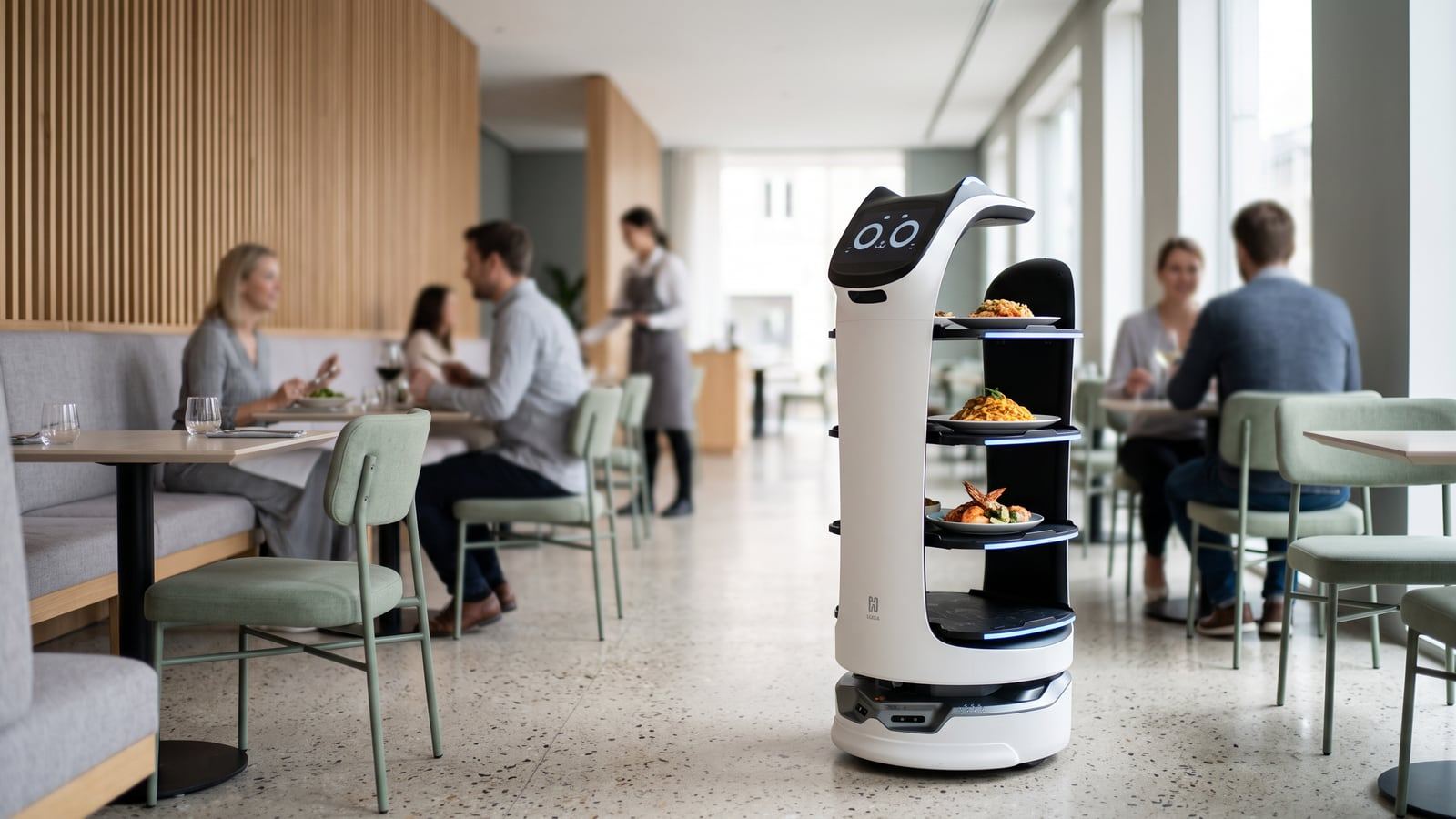
Most of the robots working today were never bought by the company using them. They arrive on a monthly contract, the way a photocopier used to. The model has a name, Robots as a Service, and according to the market report published by The Business Research Company it is worth about 32 billion dollars in 2026, up from roughly 27 billion in 2025.
That number is interesting for the obvious reason. It is more interesting for a less obvious one: renting creates a published price for an hour of robot work. Anyone can now look up what a working machine costs per month, which means anyone can calculate what one earns.
What a working robot rents for
Here is the current price list, from a 2026 vendor pricing guide that compares live RaaS offers by category. All figures are per robot per month unless noted.
| Robot | Category | Monthly rate |
|---|---|---|
| Pudu BellaBot | Restaurant service | 300 to 500 dollars |
| Keenon T8 | Restaurant service | 350 to 550 dollars |
| SoftBank Whiz | Commercial cleaning | 400 to 800 dollars |
| Bear Robotics Servi | Restaurant service | 1,500 to 2,000 dollars |
| Gaussian Voyager | Commercial cleaning | 1,500 to 2,500 dollars |
| Warehouse AMR (single unit) | Logistics | 1,500 to 3,000 dollars |
| Avidbots Neo | Commercial cleaning | 2,000 to 3,500 dollars |
| Standard Bots RO1 | Cobot | about 5 dollars per hour |
| Unitree U1 | Humanoid | about 250 dollars per day |
| AgiBot A2 | Humanoid | 899 euros per day |
Two things stand out. The spread between a restaurant robot and a humanoid is a factor of twenty, which tells you the category is not one market but several. And the cheap end is genuinely cheap: a serving robot at 400 dollars a month costs a restaurant less than a part-time shift.
The fee covers more than the machine
A RaaS contract is not a lease on hardware. The same guide lists what the monthly fee normally includes: the robot, the software platform and its updates, maintenance and repairs, remote monitoring, and a replacement machine if the hardware fails. Contracts typically run two to three years, often after a trial of three to six months.
That last item on the list is the one worth reading twice. The provider carries the downtime risk, against an uptime standard the guide puts at 95 percent and above as the industry baseline. If the robot stops, the provider fixes it or swaps it, and the customer keeps paying the same monthly rate either way.
This is the part of the robot economy nobody writes about, and it is where the actual work lives. A robot in a warehouse is not a machine that earns money. It is a machine that earns money when it runs, which is a different thing, and someone has to own that difference. In a RaaS contract, that someone is the fleet operator.
Why the contract shape matters if you own the robots
There are two sides to every one of these contracts. The restaurant pays 400 dollars a month to have a robot carry plates. Somebody collects that 400 dollars.
That collecting side is what a robot fleet actually is. Not a pile of machines, but a book of recurring contracts with published rates, known terms and a service obligation attached. It looks less like owning equipment and more like owning a small utility.
It also explains why the operating layer decides the returns. Two owners can hold identical robots and earn very differently, because one keeps machines placed with customers at 95 percent uptime and the other has units sitting in a warehouse between contracts. The hardware is the easy part now that prices have fallen. Utilisation is the hard part, and it does not fall in price.
This is why beep is built around a pool rather than around individual machines. A Robo-Pool under Swiss law holds robots across manufacturers and industries, operated professionally, so a subscriber is exposed to the utilisation of a managed fleet instead of the fate of one machine in one restaurant. The monthly logic runs both directions: the customer rents by the month, and the owner builds a position by the month.
What the price list does not tell you
Published rates are list prices. Real fleet contracts get negotiated, volume changes them, and integration and setup are frequently billed separately. The rate a customer pays is also not the margin an owner keeps: service, repairs, replacement units, software and the people who manage all of it come out of that number first. We do not guarantee returns, and a price list is not a business case.
But two years ago these numbers were not public at all. Robot work was priced privately, deal by deal, between corporations. Today a restaurant in Zurich can look up what a serving robot costs per month, sign a two-year contract, and know that if the machine breaks somebody else has to fix it.
The market for that arrangement is worth 32 billion dollars this year. Every franc of it is paid by someone who uses a robot, to someone who owns one.