
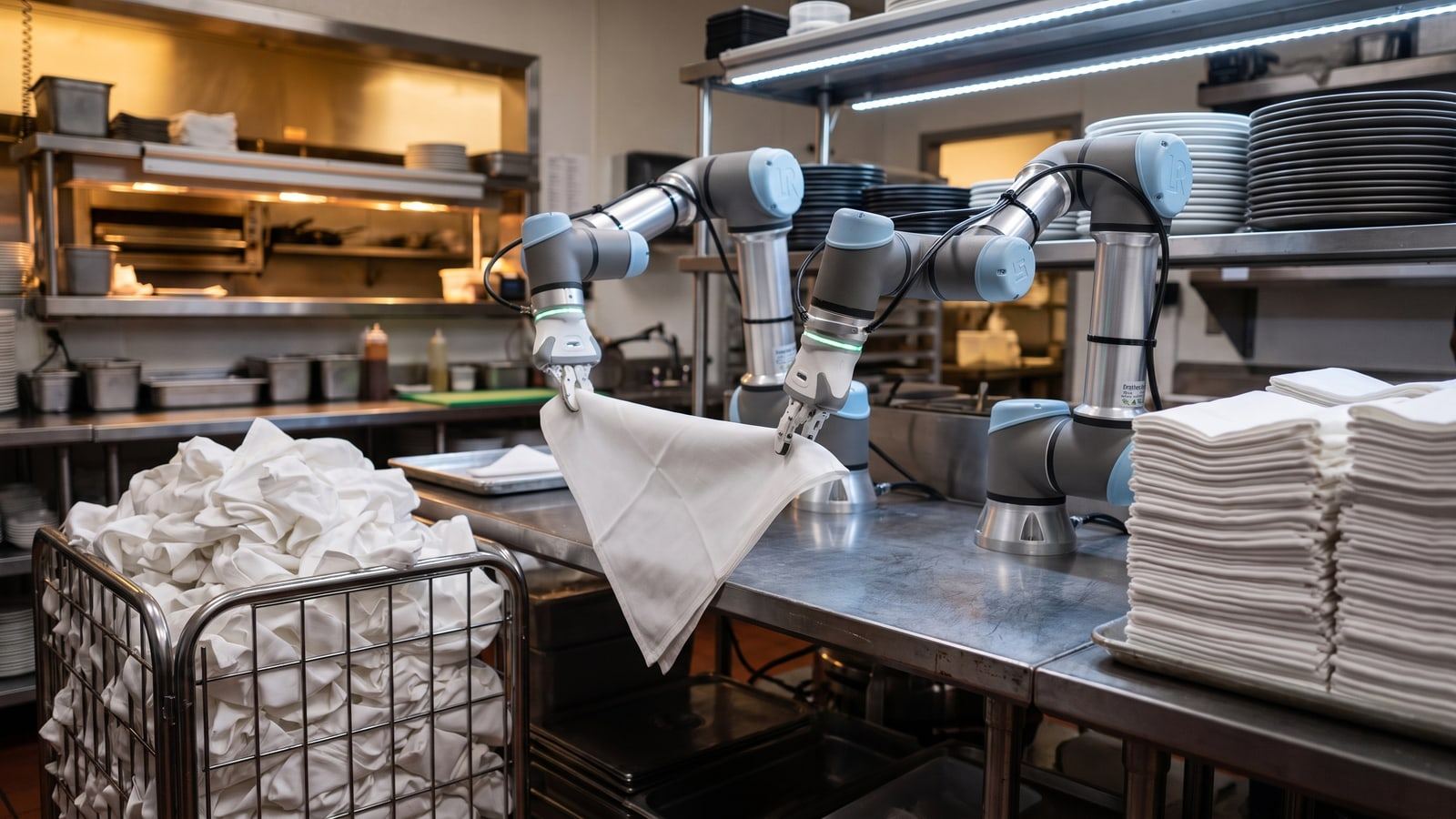
The robot videos that travel are of humanoids sprinting, dancing and falling over. The robot that passed a restaurant chain’s return-on-investment test this year folds napkins.
It folds them at Din Tai Fung, which its maker describes as the highest-revenue-per-location restaurant chain in the United States, and it folds enough of them that the chain is now rolling it out across its restaurants. For anyone who wants to own working robots, that is a more useful fact than any demo of a backflip.
What Dyna has actually deployed
Dyna Robotics, a Californian company backed by a 120 million dollar round that included Amazon, Nvidia, Samsung and Salesforce, published the numbers in August. Din Tai Fung needs 1,500 table-ready napkins from each machine over an 18-hour shift. The current model produces 1,590, and 93 percent of them meet the restaurant’s quality bar, up from 75 percent with the previous version. After a pilot that began in 2025, the system passed the chain’s return-on-investment threshold, and the rollout across its network followed.
In an interview published on 10 October, Dyna’s chief scientist Jason Ma described the rest of the business. Robots handle about 1,000 towels a day at Best Western hotels, work in gyms, and swap servers in data centres in a partnership with Lambda. The same model runs at every location with no site-specific engineering, and a new task at a new customer takes about two hours of data collection.
Why napkins
Folding napkins is not glamorous, and that is the point. The work is physical, repetitive, identical every day and needed in volume, in an industry where staff turnover is high and nobody took the job to fold 1,500 napkins. The customer can count the output at the end of the shift and decide whether it is good enough. A task that can be counted and checked is a task someone can be paid for.
Compare that with the jobs humanoids are usually filmed doing. A robot that unloads a dishwasher in a demo has not yet shown that a restaurant will pay for it every month. A robot that folds 1,590 napkins a day to a standard the restaurant set has.
The arithmetic of reliability
Ma said one thing in the interview that every owner should keep in mind: a 99 percent success rate is the starting line, not the goal. The reason is multiplication. A task made of ten steps that each succeed 99 times in 100 succeeds as a whole only about 90 times in 100. A robot that spoils one task in ten is a robot someone has to watch, and a robot someone has to watch is not saving the labour it was bought to save.
That is why the 93 percent figure for table-ready napkins matters more than the speed. It is measured against a bar the customer set, on the customer’s own floor, over a full shift.
What it means for owning robots
Three things in Dyna’s numbers are worth more to an owner than any specification sheet.
The customer set the bar. Fifteen hundred napkins a day at a stated quality is the kind of commitment an owner can underwrite: measurable output, a threshold, and a customer who has already done the maths.
Setup is short. Dyna says a new deployment can go from installation to meeting the customer’s return-on-investment bar in as little as three days. Last week we wrote that the dead time between a robot’s arrival and its first paid hour decides what it earns over its life. Two companies in two weeks are now competing on exactly that.
The most bankable robot work right now is not the most impressive. A fleet that holds only humanoids is a bet on the future. A fleet that also holds machines doing dull, countable work in restaurants, hotels and gyms earns today, which is why the beep Robo-Pool spreads across service, cleaning and industrial machines rather than one category. Our table of published rental rates shows which of those already rent by the month.
What is not proven
The volumes and quality rates are Dyna’s own figures. Din Tai Fung has not published its numbers, and neither side has said how many restaurants are covered. The hotel, gym and data-centre details come from an interview rather than a published deployment report, and no prices have been disclosed, so we know the system crossed the customer’s return-on-investment threshold but not by how much or on what terms. Folding is also a forgiving task in a controlled back room, and success there says little about messier work.
The industry will keep filming robots that run. For now the money is in the back room, where a machine folds the 1,500th napkin of the day the same way it folded the first.