
Anyone reading about robotics often hears the same stories: Tesla’s Optimus at the press conference, Boston Dynamics on YouTube, humanoids from the future’s pipeline. What gets lost is a far less spectacular truth: robots already work today. They do so in many industries simultaneously, quietly, profitably — at a speed few observers grasp in detail. This article is a tour. Six industries in which robots earn money today. No vision. No hype. The economics running beneath this silence.
Warehouses and logistics — where it began
Anyone wanting to understand today’s robotics economy starts best in a warehouse. Amazon crossed the mark of one million robots worldwide in July 2025. Three quarters of all orders at Amazon are now processed with robot support. But Amazon is not alone. DHL, FedEx, JD.com, Walmart, Alibaba — all use warehouse robots, often in the thousands.
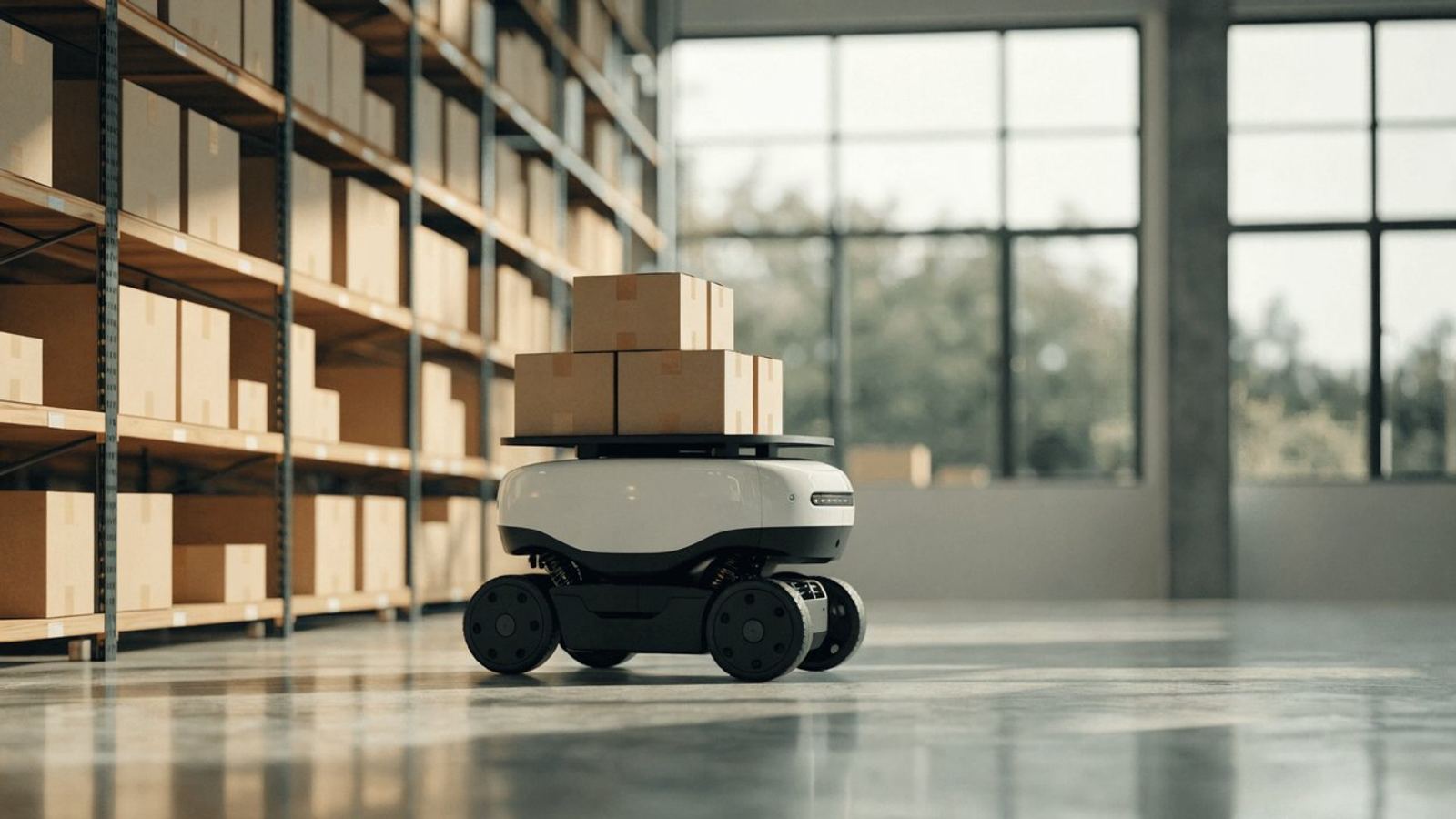
Concretely it looks like this: the PUDU T300 transports up to 300 kilograms of material in production halls and warehouse aisles — autonomously, without floor markings, with battery life of twelve hours unloaded and six hours fully loaded. The HIKROBOT CTU retrieves cartons from multiple rack levels in tight high-bay aisles and brings them to the picker. The Chinese Mushiny system inverts the classical warehouse concept: instead of humans walking to the shelves, the robots bring the shelves to the humans. Mushiny has equipped hundreds of e-commerce warehouses worldwide this way — with throughput of up to 650 bins per hour.
The economics are simple. A warehouse robot does not replace a person but dramatically raises productivity per worker. The same person who used to manage 100 picks per hour manages 400 with robot support. With rising wage costs and falling availability of workers, this pays off after 18 to 36 months — and after amortisation the robot continues to deliver value over seven to ten years of useful life.
Hospitality — the invisible service
In Asia, service robots in hotels have been standard for years. In Europe, they are just beginning to become the norm. Anyone staying in a larger hotel in Munich, Zurich or Paris today may already have seen a robot without consciously noticing it.
The PUDU FlashBot is one of these robots. It moves between floors, calls the elevator itself, navigates corridors and delivers food, laundry, parcels right to the room door. With a battery life of up to twelve hours and six-wheel suspension, it handles uneven floors and hours of continuous operation. Hotels use it at night for room service — when personnel costs are highest and staff strain is greatest.
The economics here are structured differently. A FlashBot replaces no position but changes the division of labour. Reception staff have more time for guests. Room service runs at night without an extra shift. Sickness absences and staff shortages are better cushioned. In a hotel with a hundred rooms, a FlashBot often amortises in twelve to fifteen months — and works practically without further cost thereafter.
Catering — from edge to centre
Restaurants were long sceptical of robots. The fear: they would strip the industry of its human character. Today the opposite is showing — robots are giving the staff its character back.
The PUDUBot 2 is an example. It brings trays from the kitchen pass to the table, carries used dishes back, moves drinks. What it does not do: take orders, advise, conduct the conversation. That is now again the work of the service staff — what they should be doing, before physical strain burns them out.
The numbers are clear. In restaurants using one or two service robots, table turnover rises 15 to 25 percent. Staff strain measurably falls — which reduces sickness absences and lowers turnover. At a robot price of around 15,000 euros per unit, payback is often under twelve months. In the high-price segment, sometimes under six.
Cleaning — the honest work no one wants to see
Cleaning work is among the physically hardest activities in the service economy. It is often done at night, by people no one sees, with high physical strain and high turnover. This is precisely where the first autonomous robots are already reality today.
The PUDU CC1 Pro combines sweeping, scrubbing, vacuuming and wiping in one device. With cleaning performance of 1,500 to 3,000 square metres per hour and battery life covering a full night, it cleans office buildings, shopping centres and airports — quietly, systematically, without pause. A built-in AI camera monitors cleaning quality in real time and starts a re-cleaning pass for missed stains.
The economics follow a simple logic: cleaning robots replace work that is hard to fill, has high turnover, and must be organised in shifts anyway. In a mid-sized shopping centre with 20,000 square metres of floor area, a CC1 Pro amortises within 18 months — and works every day of the week afterwards, without wage costs, without breaks, without effort.
Health and wellness — where touch becomes valuable again
A particularly fast-growing field is robotics in health and wellness. This is not about replacing medical professions — those will continue to be needed, more than ever. It is about the routine, physically demanding activities in spas, physiotherapy practices and care facilities.
The Realman Healthcare Robot is one example. It reproduces massage techniques with infrared thermal imaging and flexible force control. A robotic arm with 5 kilograms payload at just 7.2 kilograms own weight — precise, durable, safe. Spas in China have used these robots for years as a complement to human staff. In Europe, the first wellness hotels are beginning to test the concept.
In hospital logistics, robots today move medicines, laundry and materials between stations — a task previously performed by nursing staff alongside their actual work at the patient. The economics here are often double: the robots save direct costs, and they give highly qualified staff time back for the work they were trained for.
Production — the old world of industry
Finally, the industry where robotics has been earning money the longest: classical production. Industrial robots have worked in factories since the 1970s — welding, painting, assembling, packaging. They have become so taken for granted that no one talks about them anymore. But they are the economic foundation on which all other robotics categories rest.
The International Federation of Robotics reports a global stock of around four million industrial robots in 2024. China leads by far, followed by Japan, South Korea, the US and Germany. An average industrial robot installation amortises today within 24 to 36 months — and works ten to fifteen years thereafter, often with minimal maintenance effort.
The next generation brings humanoid robots into the same production environments. Boston Dynamics’ electric Atlas has been in pilot installations at Hyundai since 2024. Figure 03 is expected on the first production lines from 2026. Tesla is testing Optimus in its own plants. What these robots do that is new: they work in environments built for humans — without infrastructure having to be rebuilt.
The pattern emerging
When you look at these six industries together, a clear pattern emerges. Robots today do not replace whole professions. They replace the straining, repetitive, hard-to-fill parts of professions. They raise productivity without pushing people out of the working world. And they do so at a speed that increases each year.
At beep, we are building a pool that contains exactly these robots — diversified across the categories named here. PUDU T300, FlashBot, CC1 Pro, PUDUBot 2, Realman, industrial robots, later humanoid platforms. Not because individual models are special, but because the mix distributes economic risk while covering the broad shift.
Anyone thinking about robotics today often thinks too spectacularly. The real story is more boring. And therefore more reliable. Robots already earn money today, in industries everyone knows. The only question is who will share in it over the next ten years.