
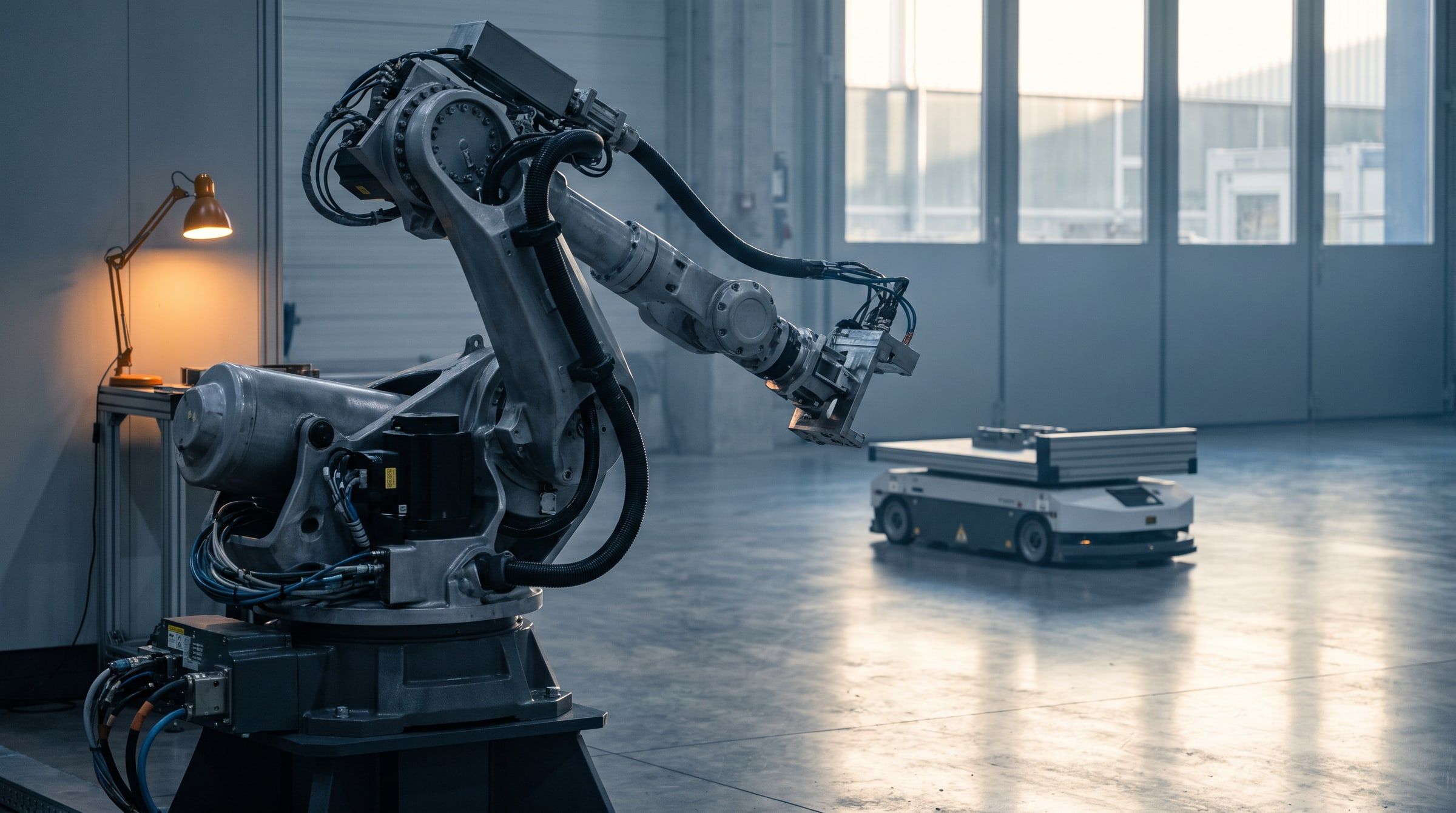
There is a moment in every founder’s life when an idea hits the head for the first time — and stays there. For beep, this moment came early, in a conversation about the consequences of the AI revolution for the world of work. The question was simple: if robots increasingly take over work, who owns what they earn? And what happens to the people whose work is replaced? We did not know then that this question would become a company. We only knew the answer could not be “nothing”.
Where the idea came from
We do not come from the crypto world. What interested us about tokenisation was never speculation, but infrastructure. The possibility of making ownership of real things available in smaller units. The possibility of giving people a share in value creation that otherwise disappears behind corporate walls.
Switzerland was, from the beginning, the only sensible address for us. Not out of patriotism, but for legal reasons. The DLT Act of 2021 created a framework here that exists nowhere else in the world with such clarity. Tokenised securities have the same legal status as classical securities. That is the ground on which you can build a company like beep — without slipping into a regulatory grey zone.
We founded Beep Labs AG in Zug. We engaged legal counsel from one of the leading Swiss firms in blockchain law. We took the time to set up the legal structure cleanly before planning marketing. This order matters — and it is rare in our industry.
Why robots
Robots were not the first thought. The first thought was: what is the most valuable resource that has not yet been tokenised? Real estate, shares, bonds, commodities — all of these already exist in tokenised form. We were looking for something that was at once real, scarce, growing and socially relevant.
Three insights led us to robotics.
First: the robotics economy is growing exponentially. The global market is projected to reach over 205 billion US dollars by 2030, the humanoid market is expected to grow ninefold. This is not theory — these are the numbers already in quarterly reports and industry studies.
Second: the value creation of robots today flows almost entirely to the companies operating them. Amazon, Tesla, Foxconn, Hyundai. That is not wrong, but it is not everything. There is a huge space for a different logic — one in which private individuals also share in this value creation.
Third: the legal foundation exists. An asset token backed by a real robot fleet can be structured cleanly under Swiss DLT law. It is doable, not just thinkable.
That was the moment when the idea of beep became concrete. Not another crypto token. A digital security backed by working robots.
Why time
One question remained: how exactly do we define what stands behind the token? How do we make robot work tangible?
The answer was simpler than we thought. What a robot fleet produces is ultimately time. Every robot that works delivers a certain number of hours of work. These hours can be broken down into seconds. And every second of robot work has a market price — the hourly rate at which the robot is deployed, divided by three thousand six hundred.
From this followed our central logic: one token = one second. This is not meant poetically, but economically precisely. Every beep token represents one second from the total working time of our robot fleet.
This choice gave us two advantages. First, it is understandable. Whoever buys a token knows exactly what they get: a share of robot work, in a unit every person understands. Second, it fits our long-term vision: if we manage to give every second of robot work a real value, the next step is to give every second of human attention a real value.
We make time liquid. In the first step, the time of robots. In the second step — when the models are ready — the time of people.
What drove us
There was a moment early in the planning when an advisor told us: “Make it simpler. Drop the time story. Just say you’re investing in robots. Everyone understands that.”
He was right — and he was wrong. He was right that a simplified story would have been faster to convey. He was wrong because we did not want to build just another robotics fund. We wanted a different logic. One in which every person can participate. One in which every second counts. One that addresses not only investors, but everyone who would otherwise be excluded from the value creation of the coming decade.
That was the moment when it became clear: beep is not primarily a financial product. It is a vision that can be implemented financially. The difference sounds small. It is large.
What we do not promise
One of our most important design principles — and one of the hardest points in the sales discussion — is the question of what we promise customers.
We promise no returns. We promise no distributions. We promise no guarantees.
This sounds weak. It is the opposite. In an industry in which many providers make aggressive promises that are legally precarious and often practically unkeepable, restraint is a form of strength. Those who make no promises cannot break any. Those who describe real mechanisms — robot value creation, structural buybacks, token scarcity — give their customers more than a promise. They give them transparency.
This is not marketing speak. This is the logic with which we run the company. And it is the logic with which we want to build trust — not through grand words, but through clean mechanics.
Where we stand today
At beep, we are at the beginning of a long journey. We are in the pioneer phase. We are building the first generation of the Robo-Pool. We are setting up the token infrastructure on Ethereum. We are talking with robot manufacturers, operators, customers, partners.
We know the coming years will not be easy. We know we will make mistakes. We know the regulatory landscape will continue to evolve, the technology will continue to evolve, the market dynamics will continue to evolve.
What we also know: the question that gave us the initial impulse will be asked by many people in the next ten years. Who owns the robots taking over our work? Who benefits from their work?
We have built an answer. One of many possible ones, presumably. But one we pursue with conviction.
If this thought interests you, write to us. We are not building this alone. We are building it for everyone who wants to join.