
Bitcoin was a joke in 2013. A plaything for tech enthusiasts and libertarians. Anyone who invested twenty dollars then would have more than a small fortune today — if they had had the nerve to hold on long enough. The majority did not. AI was an academic discipline in 2018. No one understood what language models would mean economically. Anyone who invested in NVIDIA back then because they suspected GPUs would one day be central was a genius or a lucky hand — depending on whom you ask. The stock has multiplied many times since.
The question is not whether the next big wave is coming. The question is what it is, and who recognises it early enough.
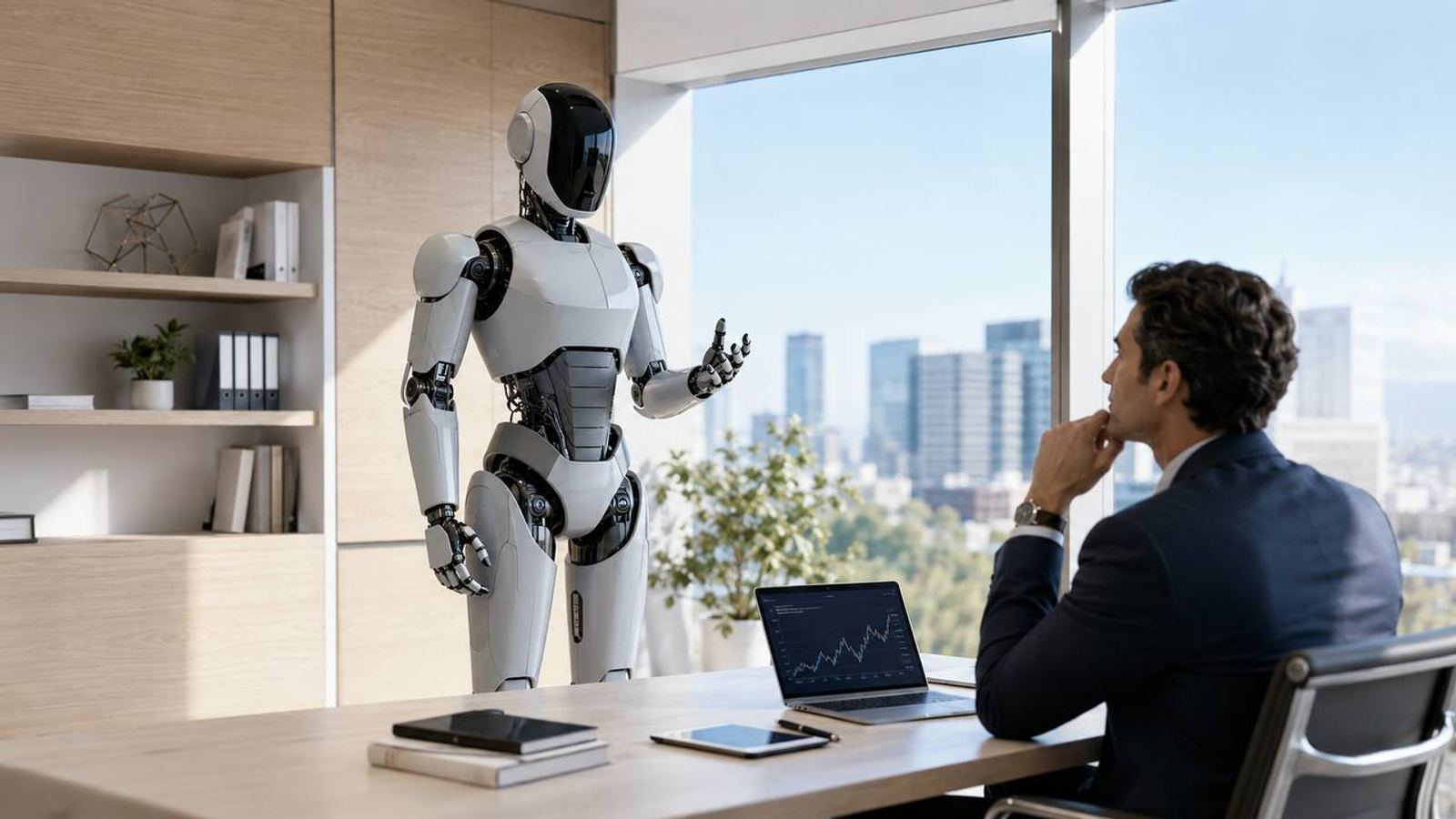
Here is my thesis: the next wave has two legs. Literally. It is tokenised robotics. And today it stands roughly where Bitcoin stood in 2013: technically functional, increasingly regulated, but still largely overlooked by the broader public.
Why the combination matters
Robotics alone is not new. Robots have worked in industry for decades. What is new are three things happening simultaneously: first, the leap from industrial robots to service and humanoid robots usable in far broader industries. Second, the exponential decline in unit costs. Third, the legal possibility of participating in this value creation through tokenised structures.
It is the third point that most observers overlook. Robotics as an asset class has been reserved for institutional investors. Anyone wanting to invest in a robot fleet needed millions, a consulting team, contracts, their own structure. Asset tokens on the blockchain make it possible — for the first time in history — for private investors to participate in this asset class. In small units, with a clear legal basis, without having to buy, maintain or manage robots themselves.
This is the difference between an interesting technology and a new asset class. The technology has existed for years. The asset class is emerging right now.
The numbers no one quotes
The global robotics market is projected to grow from around 90 billion US dollars in 2024 to over 205 billion US dollars by 2030. More aggressive estimates reach up to 365 billion. That is an average annual growth rate between 15 and 19 percent — over a six-year period.
For comparison: Bitcoin stood at around 100 US dollars in 2013. Anyone who invested ten thousand dollars then and never sold would have several million today. Not every market behaves this way. But markets growing at 15 percent annually quadruple over ten years. They grow sixteenfold over twenty.
A different number is more important: Goldman Sachs projects the humanoid robot market to grow ninefold by 2030. That is not a twenty-year estimate. That is six years. A growth dynamic comparable only to the early phases of the internet, smartphone and AI.
Who is already in
Anyone who thinks robotics is a vision of the future has missed the last two years.
Amazon operates over a million robots in its warehouses. Pudu Robotics from China has delivered over a hundred thousand service robots worldwide. Hikrobot, also from China, is the market leader in warehouse automation. Mushiny has equipped hundreds of e-commerce warehouses worldwide with goods-to-person systems.
The humanoid wave has begun. Tesla is building Optimus. Figure AI has unveiled the third generation of its robot. Boston Dynamics is moving the electric Atlas into series production. 1X Technologies from Norway has brought Neo, the first humanoid robot for domestic use, to market.
These companies sell robots today. They generate revenue today. They operate in real markets today. This is not speculation on a distant future. It is the present, accelerating right now.
Why Switzerland is at the centre
For an asset class to become serious, it needs a serious legal home. For shares, those are the major exchange centres. For bonds, the financial metropolises. For tokenised robotics, it will probably be Switzerland.
The reason is the DLT Act of 2021. It creates the concept of register value rights — securities that exist not physically but as entries on a blockchain. This gives tokenised assets in Switzerland the same legal status as classical securities.
In no other major financial market is the situation so clearly regulated. The EU is working towards convergence with MiCAR. The US is moving, but slowly. Singapore has its own frameworks that are less developed. Switzerland has a head start of years — and is using it.
Companies like Sygnum, Aktionariat, SIX Digital Exchange and Beep Labs work within this framework. They are building what will be taken for granted in ten years: tokenised assets as a serious, regulated asset class.
The advantage of looking early
Anyone who recognised Bitcoin in 2013 had an advantage. Not because they were a genius, but because they looked when others looked away.
Anyone who recognised NVIDIA in 2018 had the same advantage. Again, not from genius, but from observation. The indicators were there. They were simply not taken seriously.
In tokenised robotics, the indicators are likewise there. The robotics market is growing exponentially. The humanoid wave has begun. The legal infrastructure in Switzerland is in place. First companies — like Beep Labs — are building the models that will later be the standard.
This does not mean every token in this category is a good idea. There is wheat, and there is chaff. Anyone navigating here with the necessary care — examining what assets stand behind the token, how the legal structure looks, how the company is run — will find models that are serious, and those that are not.
The uncomfortable conclusion
Bitcoin is not the end of a story. It is the first chapter of a longer one. Crypto in its speculative form was the practice stage. Tokenised real assets are the main stage. And tokenised robotics is one of the first major applications in which this main stage shows itself.
Most will miss it because they confuse the story with “Bitcoin and similar”. That is understandable — the crypto industry has long done everything to encourage this confusion. But it is an expensive confusion.
Anyone looking today, anyone checking, anyone asking, anyone studying the regulatory clarity of Switzerland and the economic substance behind the models — has a head start the majority will only recognise in a few years.
Forget Bitcoin. The next asset class has two legs. It is already working. And it is about to ask you whether you are coming along.